Asia | US news digest. 21 July
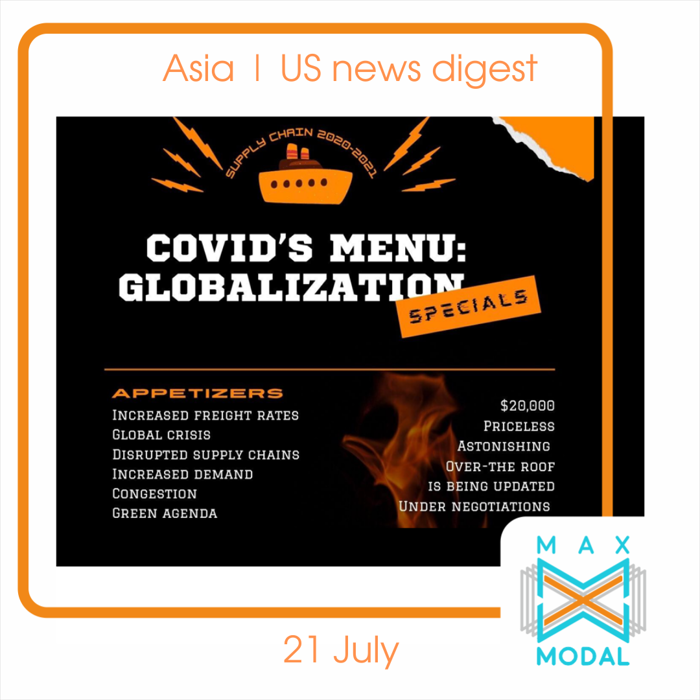
To paraphrase the classic: COVID eats globalization for breakfast.
The port congestion pandemic has truly become global, as it has spread out across five continents with 116 ports reporting disruption. The current situation differs from the time of Yantian: there is now the doubling of ships waiting outside Asian transhipment giant Singapore as well as the new pain points at twin ports of Los Angeles and Long Beach. Schedule reliability is still way down on pre-pandemic levels. In the light of these events, experts warn that even after Yantian goes back to normal fully, the aftershocks will be felt far and wide.
While trying to stay afloat skyrocketing rates and survive the pressure on the supply chain, the majority of the companies do not make customer service its main concern. The recent feedbacks have highlighted the lack of transparency. In turn, industry players blame blank sailings despite the high demand, which raises many questions and ignores the needs of long-standing shippers. Experts also note that the growing freight rates will push companies to switch to local sources than to transport, especially in the case of raw materials.
The situation gets more challenging as Bangladesh closes factories for 19 days due to the main reasons: Eid ul Azha festival, weekly holidays, and pandemic restrictions. Among the shutdown sectors is the top foreign currency earner apparel industry, which is directly affecting shipment of cargoes. Huge tolls are expected to take place as the peak season approaches, stores in western nations open, and demand is on the rise.
Vietnam is struggling – there is a challenging situation in the southern part of it due to congestion at previous ports. Cargo is often delayed due to congestion at transhipment ports like Singapore, or Chinese hubs. In the aftermath, there is also a lack of space and equipment. It is reported that shippers are waiting for lower rates, which is also a cause of delays.
The context is so hectic that Cosco has retrofitted an open-hatch cargo ship belonging to affiliate Cosco Shipping Specialised Carriers. The move will offer a temporary solution to the limited supply of containerships. Originally, the vessel was built to carry paper pulp cargo, but for the time being, it will be deployed to carry containers between Ningbo-Zhoushan and Brazil’s Santos port. This is not the only case. In general, experts comment that companies are starting to deploy any ship that can float.
Meanwhile, FMC is fighting its own battle. The US Federal Maritime Commission has established an audit program to assess carrier compliance with the agency’s rule on detention and demurrage. The top nine carriers will be taken for analysis. It may also review practices related to billing, appeals procedures, penalties assessed by the lines, and other restrictive practices. One thing is obvious – the government is determined to take action to cool down the nation’s overheated logistics sector. Among further changes, there potentially may be adjustments in FMC regulations and industry guidance.
Not only European railways have been suffering severe floods. China has been hit as well. The flood in Zhengzhou, one of the major consolidation centers for China-Europe trains, is putting the city under a red alert. However, the loss of goods accumulated in the warehouses is not significant thanks to the precautions taken before the rain.
The already mentioned constraints at US major ports are not the only challenges. Rail follows suit. MSC has reported that U.S. freight railroads have started to reduce import rail traffic at the ports of Los Angeles and Long Beach as well as New York due to the record import volumes. Consequently, the delivery of onboard or discharged cargoes to Chicago will be impacted since cargo will be held at marine terminals until the restriction is lifted.
Following the European Green Deal, many companies have realized the need to find greener ways to transport their goods. This is where New Silk Way Logistics can come in handy, as it can ship temperature-controlled goods from Europe to China with zero carbon emissions. The company’s main project – a reefer container, the Coolbox – provides a more economical and ecological approach.
The Northwest Seaport Alliance continues to face a huge growth in TEU volume. The new data shows that the volume has improved 18.9% to 1,860,174 TEU, with full imports growing 31.1% and full exports declining 11.2%. As the situation escalates, many call for the Federal Government to do more to alleviate pressure.