
A loophole allowing ocean carriers to dodge ETS charges via a port call in the UK could soon be closed, thanks to a government effort to expand the UK’s ETS scheme.
Parliament is mulling adding deepsea shipping to the UK emissions trading scheme (ETS) that currently includes power plants, factories and airlines, as well as domestic shipping – however the current legislation does not include international shipping calls at UK ports, thus creating a loophole that allows European importers to pay reduced ETS charges.
The UK ‘scheme’ is not to be confused with its EU counterpart, which is an emissions trading ‘system’.
“Expanding the scheme to include the maritime sector… will ensure that the price of fuels used by the sector better reflects their environmental impact,” the UK ETS Authority said late last week.
Vessels which call at EU ports from ports outside the region must pay a charge equivalent to 50% of their ETS emissions charges. But by calling at a UK port like Southampton or Felixstowe first, they can pay a fraction of these fees.
MSC has launched a Britannia service, which from February when it formally launches its standalone network includes a call at Felixstowe before proceeding to Antwerp, while its Albatross service will see calls at Felixstowe and then London Gateway before Rotterdam; and Hapag-Lloyd’s expanded China Germany Express will call at Southampton first when it introduces a new port rotation in January.
Apart from the hit to the EU’s decarbonisation goals, OceanScore MD Albrecht Grell said the UK loophole would tie-up ship capacity, inflate freight rates and could cause disruption as carriers queue up at UK ports.
“We need to consider that UK ports do not have the capacity to handle significant increases in throughput, so more port congestion, time lost, would have to be considered,” he said.
A report published in May shows that the UK government has already recognised this, acknowledging: “…Operators wishing to ship goods to and from Europe can largely avoid the EU emissions trading scheme by using UK ports to ship goods to and from EU destinations.
“Failure to align the UK ETS with the EU ETS provisions for international shipping risks the promotion of carbon leakage,” the report adds.
Mr Grell added that he did not expect the loophole to last for long at any rate, as the EU is planning to review its ETS from 2026.
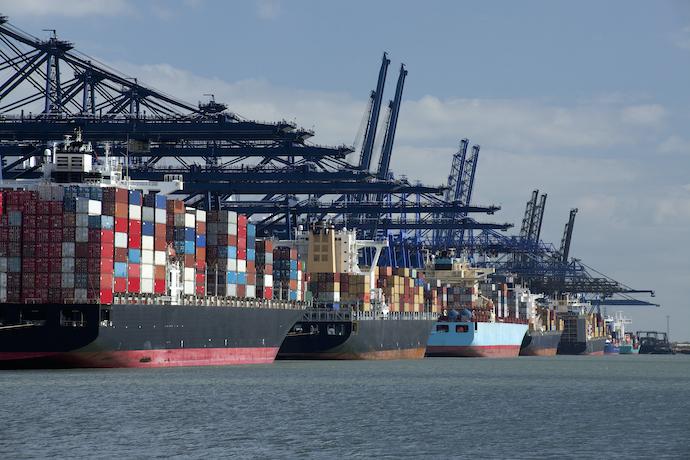

With MSC to begin weekly calls at India’s new transhipment hub of Vizhinjam, feeder operators have begun talks with operator Adani to sign on for coastal connectivity operations.
MSC has published an enhanced east-west network schedule and will begin offering weekly mainline calls out of Vizhinjam, India’s high-stakes container transhipment project, from February.
Vizhinjam in southern India is under a long-term concession with Adani Group, which continues to expand its port interests.
The new network shows MSC extending its Jade and Dragon loops, covering Asia-Europe trades, to Vizhinjam, redefining its hub interests in the region.
The move follows a series of pilot calls by the carrier – a development observers believe has the potential for Vizhinjam to attract subcontinental transhipment market share from Sri Lanka’s Colombo.
Adani Ports and MSC already have terminal partnerships in India – at Mundra on the west coast and Ennore on the east – and speculation has been rife that the liner giant would extend that collaboration to Vizhinjam.
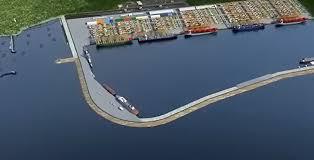
With Vizhinjam operations eyeing a 1m teu capacity in the first phase, regular mainline services would provide an opportunity for feeder lines to run services connecting other ports in the subcontinent area.
Although MSC usually uses its own feeder tonnage, Mumbai-based Sima Marine is one operator showing firm interest and is believed to be close to setting up a network at Vizhinjam, sources say.
“We have received interest calls from many coastal shipping operators,” a source at Adani Group told The Loadstar. “Coastal networks are critical to transhipment cargo flows.”
Vizhinjam has had a powerful start, handling some 100,000 teu in the first four months of trial ship runs last month, according to available data. Sensing the potential, Phase 2 development has been advanced to 2028 and will push annual capacity to some 4m teu on completion.
Maersk was the first mainline carrier to trial a call at Vizhinjam – by the 8,714 teu San Fernando on 11 July, which saw some 6,900 teu exchanged.
But despite expectations, the Danish carrier is understood to be waiting for operations at Vizhinjam to “stabilise” after the terminal officially goes live next month, before making regular calls.
“The trial run made by the San Fernando wasn’t up to the mark, as things were just beginning to take shape then,” said a Maersk source. “Operations might have improved and streamlined by now, though.”
And the source was non-committal when asked if Vizhinjam could become a port of call for services run by the upcoming Gemini Cooperation and/or its secondary networks.
Meanwhile, Adani is rapidly consolidating its Indian terminal presence with its latest concession at Kolkata Port, a five-year contract for two berths scheduled to begin next month.
Despite the recent controversy sparked by an indictment by US prosecutors, the diversified conglomerate claims it continues to enjoy strong backing from its investor and partner networks, including Abu Dhabi’s International Holding Co. Adani also claims its container terminal development at Colombo – nearing completion – continues to be supported by the port authority.
And the latest outlook report by market research firm CRISIL today adds to those positive claims. The agency said: “Adani Group has sufficient liquidity and operational cash flows to meet debt obligation and committed capex plans over the medium term.”

Welcome a new company on MaxModal. You can see Rhenus Intermodal LLC services on their business profile, drop them a message, add them to your contacts or submit a special request to them

Get the link for freight rates by many providers on maxmodal.com


Indian shippers are fearful of major supply chain disruptions after dockworkers called for strikes at key ports, claiming the government has failed to meet commitments.
A consortium of labour groups told port authorities workers would stage indefinite work stoppages across ports from 17 December in protest at the lack of action to address long-standing concerns.
The move centres on wage revisions and pension benefits. Union sources complained that governing body the Indian Ports Association (IPA) had been “apathetic” about making recommendations in line with specific promises made during talks to avert a strike planned in August.
“It is imperative on the part of the IPA to forward the settlement to all the port authorities for implementation, as per the practice hitherto followed,” said the labour consortium.
“It is highly objectionable to state that, even after a lapse of two months after signing the settlement, it was not forwarded to the authorities for implementation,” they added.
Union leaders also said workers would hold rallies at port locations on 5 December to highlight their grievances, as part of preparations for the industrial action.
A productivity-linked reward (PLR) scheme remains at the heart of the impasse, and needs to be approved by the federal government retroactively to 2021. With no PLR guidelines in place, interim retirees from the ports have lost such benefits, unions claim.
“The workers and pensioners are restless, and [they are] compelled to go on industrial action against the non-implementation of statutory settlements,” said the labour groups.
According to IPA sources, the ministry of shipping needed to issue an order approving wage revisions for port workers, which “has been delayed”, one official told.
The source of funding to cover additional overheads by the government ports, amid growing market share challenges from the private port sector, could be a major reason pushing the decision back at government level, according to industry observers.
There are 12 government-controlled ports in India, but Adani Ports-run Mundra recently overtook Nhava Sheva to become India’s busiest container gateway. Similarly, Chennai has ceded a significant portion of its southern Indian containerised trade to Kattupalli Port, also managed by Adani.
Meanwhile, the likelihood of port disruption comes as Indian exports are showing some signs of a rebound after recent downward trends. In October, the value of India’s exports swelled 17% year on year, boosting industry sentiment.
“An impressive double-digit growth in merchandise exports amid continuing global economic uncertainties is definitely very encouraging,” said Ashwani Kumar, president of the Federation of Indian Export Organisations.
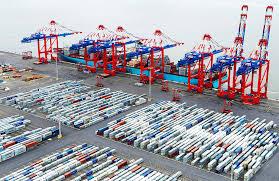

The global shipping industry has observed diverse trends among leading container ports worldwide, reflecting significant changes in connectivity and cargo volumes that influence the competitive landscape across the Far East, Middle East and Trans-Atlantic.
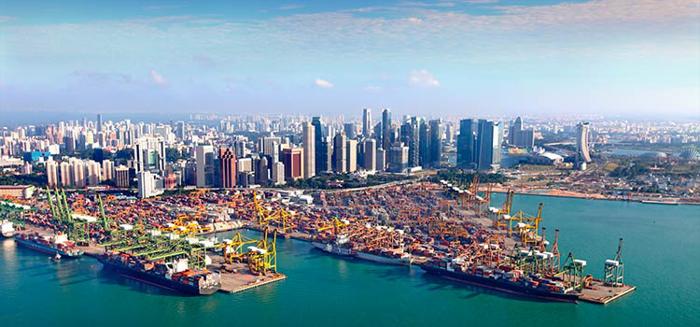
The Far East continues to spearhead global container shipping, with major ports like Shanghai, Singapore, Ningbo, and Busan at the forefront. Shanghai led globally with a record 49.16 million TEUs in 2023, closely followed by Singapore with 39.01 million TEUs. Between Q1 2023 and Q3 2024, connectivity in the Far East rose by 4.57%, solidifying its position as a key shipping region.
Additionally, the Middle East, with pivotal ports like Jebel Ali and Tangier, experienced a 2.75% increase in connectivity from Q1 2023 to Q3 2024, highlighting its strategic role as a nexus for East-West trade.
The region’s connectivity growth is part of broader efforts to diversify economies and enhance logistics infrastructures, establishing it as a crucial hub for transshipment and international trade. However, it still remains behind the Far East in terms of overall connectivity and cargo volumes.
While the Far East demonstrates robust throughput and connectivity, the Middle East is leveraging its strategic location to enhance its market position, albeit at a more moderate pace.
Meanwhile, critical ports in the Trans-Atlantic route, linking North American and European markets, saw a marginal reduction in connectivity, with an average drop of 0.63% during the same period. Despite this, the Trans-Atlantic corridor remains a pivotal axis for containerized trade.
These trends indicate a shift in global maritime trade towards Southeast Asia, with the Middle East serving as a critical transshipment hub that bridges Europe and Asia amid broader economic diversification efforts by Arab states.

Container spot rates were largely unchanged for a third consecutive week, as it became evident that a 15 November rate hike on Asia-Europe trades had failed to have anything more than a marginal impact on pricing.
Drewry’s World Container Index (WCI) global composite rate declined 1%, although its Shanghai-Rotterdam leg edged up 1% and ended the week on $4,071 per 40ft, while the Shanghai-Genoa route was up 3% week on week, to $4,520 per 40ft.
Although these rates are some 255% and 229% higher year on year, forwarders on the trades remarked that repeated attempts recently by carriers to further lift spot freight rates appeared to have had little effect, and they were sceptical that the effect of new FAK (freight all kinds) rate levels scheduled for 1 December would be any different.
Traditionally, the final two months of the calendar year would see carriers and their customers hammering out the terms of the following year’s Asia-Europe annual contracts, and the level at which they are set is often guided by spot rate behaviour. Now, the trade waits to see if the 1 December FAK hikes stick.
This morning, CMA CGM announced an FAK of $6,500 per 40ft on Asia-West Mediterranean ports, the same rate MSC announced earlier this week, while Hapag-Lloyd will set a rate of $6,100 to North Europe and $6,400 to the West Mediterranean on the same date.
Given that achieving carriers’ desired rate levels would require a 50% week-on-week increase in Asia-Europe spot rates, the chances of these FAK hikes fully sticking appear to be close to zero.
Meanwhile, the calendar for the Asia-Europe contracts appears to have slid from a January-December set-up to Q1-to-Q1 arrangement, with many shippers reluctant to sign anything before Chinese New Year, set to begin on 27 January.
“We’ve had a busy tender season so far, but most clients seem to be holding out on negotiations post-CNY, which makes sense,” told one forwarder.
This was confirmed last week by Hapag-Lloyd CEO Rolf Habben Jansen, who told analysts during the company’s third-quarter earnings call that “it is still very early for the Far East contracting season”.
He added: “Yes, negotiations have started in many cases, but most of those contracts will only be closed in the first quarter.” And he said that, of “the early ones that have been closed, there we definitely see that rates are up. They don’t go to the level of spots, but they are definitely up compared to what we had before”.
Meanwhile, the WCI’s Shanghai-Los Angeles spot rate shed 5% this week, down to $4,488 per 40ft, while the Shanghai-New York leg was flat, at $5,210 per 40ft.
Carrier attempts to raise prices have seen a number of blank sailings announced in a short-term measure to curtail capacity – Drewry’s Cancelled Sailings Tracker reports 70 sailings cancelled between next week and the end of the year, representing some 10% of scheduled departures globally.
It said that 50% of these would be on the transpacific eastbound trade, 27% on the transatlantic westbound and 23% on Asia-Europe westbound, and the consultancy warned shippers and forwarders that further blanks could be on their way, while schedule reliability may also take a hit.
''Over the next five weeks, we anticipate a decline in schedule reliability, with approximately 10% of vessels expected to miss their scheduled sailings.
“To sustain higher rates, carriers are likely to implement additional cancellations, cargo owners operating in this trade should proactively prepare for potential disruptions,” it said.
Get the link for freight rates by many providers on maxmodal.com

Container spot freight rates this week were virtually unchanged from last week, as planned mid-November rate increases from carriers have, apparently, failed to stick.
There was a marginal 2% increase on the Drewry World Container Index (WCI) Shanghai-Rotterdam leg, which finished the week at $4,043 per 40ft, while Shanghai- Genoa was unchanged, at $4,400.
Asai-Europe carriers and shippers have now begun the annual negotiations on 2025 contracts, and carriers are keen to hike spot rates – which act as a guide for contract rate levels – as high as possible, and this week’s lack of movement will undoubtedly disappoint.
The current WCI Asai-North Europe rate is far below the levels targeted by some carriers for 15 November: MSC was aiming for a new FAK rate of 5,500 per 40ft for Asia-North Europe shipments, for example; while CMA CGM targeted $5,700 per 40ft on Asia-West Mediterranean shipments.
But carriers are likely to have another go at the end of the month. MSC and Hapag-Lloyd have announced new Asia-Europe FAK rates to be implemented on 1 December, with MSC asking for $6,300 per 40ft from the Far East to North Europe, while Hapag-Lloyd is aiming for $6,100 per 40ft to North Europe, and $6,400 for West Mediterranean ports.
During yesterday’s third-quarter earnings call with analysts, Hapag-Lloyd CEO Rolf Habben Jansen revealed that the few 2025 contracts already concluded were up on 2024 levels, with spot rates currently far above the corresponding level at this point last year, although he added that the contracting calendar had slipped somewhat on the trade.
“It is still very early for the Far East contracting season. Negotiations have started in many cases, but most of those contracts will only be closed in the first quarter [of next year].
“Of course, the early ones that have been closed, there we definitely see that rates are up. They don’t go to the level of spots, but they are definitely up compared with what we had before.
“Also, don’t forget that many of the contracts last year were closed before we had the Red Sea crisis, so our costs are up significantly,” he added.
On the transpacific, there was also very little spot rate movement: the WCI’s Shanghai-Los Angeles leg contracted 2% week on week, to end at $4,700 per 40ft, while Shanghai-New York was unchanged, at $5,222 per 40ft.
One bright spot for container shipping lines is the intra-Asia trade. Drewery recently launched a fortnightly intra-Asia spot rate index, a composite of 18 routes, comprising north and South-east Asia, and China-Middle East/India services, which today recorded a 45% rise in price over the past fortnight, to stand at an average rate of $829 per 40ft.
Drewry said the increase had been seen “amid the pre-Christmas cargo rush”, and expected this “to continue in the next fortnight of November, due to tight space, traditional shipping peak season, blank sailings and other factors”.
Welcome a new company on MaxModal. You can see Indaiá Logística Internacional e Integrada Ltda services on their business profile, drop them a message, add them to your contacts or submit a special request to them