
US shipbuilding ambitions have observers scratching their heads on the viability, funds required, and their likely provenance, as well as potential repercussions for cargo owners and logistics providers.
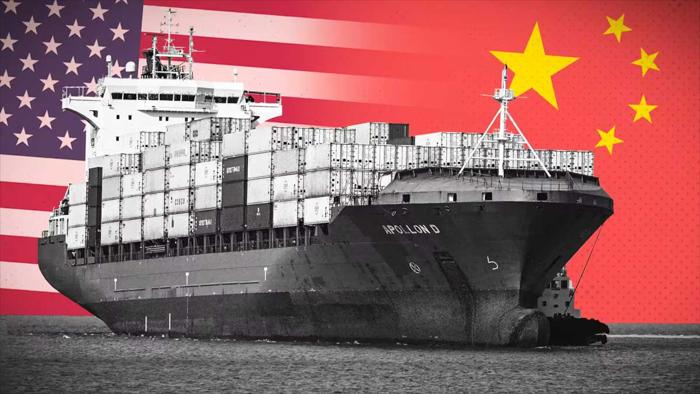
The US is moving closer to a grand push to revive its shipbuilding industry. The report on a probe into unfair practices in Chinese shipbuilding, released last week, is providing fresh ammunition for supporters of the Shipbuilding and Harbor Infrastructure for Prosperity and Security for America Act, a bipartisan legislative proposal introduced to Congress on 19 December.
The probe, launched last April, concluded that China had used unfair policies and practices to dominate global maritime, logistics and shipbuilding sectors, with measures ranging from state financial support to intellectual property theft and forced technology transfer.
Vessels built in China accounted for more 50% of the global activity in this sector in 2023, while US shipbuilding activity has shrunk since the end of World War II, when 80 firms were producing ships, to 20 today.
For decades, vessel owners, like virtually everybody else, were happy to procure from the source offering the lowest cost – China, said Lars Jensen, CEO of shipping consultancy Vespucci Maritime. Now the US is looking at the issue through the lens of national security, as it lacks a sufficiently large fleet of US-flagged support vessels for the navy, he explained.
Marine investors are already in high spirits. At Marine Money’s annual conference in New Orleans in November, the mood was upbeat in expectation of a promised resumption of offshore drilling that would boost demand for support vessels. The SHIPS Act promises further momentum.
The proposed legislation calls for the production of 250 US-built ships within 10 years. The authors of the bill have not provided a breakdown of vessel requirement by category; the scope appears to be quite broad.
“They pour this over everything, including container shipping,” Mr Jensen noted.
To inject money into US shipbuilding, the legislation calls for the establishment of a Maritime Security Trust Fund to funnel $250m a year to US shipyards and proposes an incentives programme centred around a 25% investment tax credit.
However, observers do not think that this will suffice. By some estimates, revitalising the US shipbuilding industry would require tens of billions of dollars.
Not surprisingly, the new administration is looking to raise some money from Chinese-built vessels calling at US ports. But Mr Jensen has reservations: for one thing, carrier alliances could switch vessels to avoid a US ship charge, he pointed out.
Additional money could come from fines levied on cargo owners that fail to meet the provision in the legislation that 10% of commercial goods imported from China would have to move aboard US-flagged vessels, starting in 2029. But implementing this would be “extraordinarily problematic”, warned Mr Jensen.
And US legislators may want to extend that provision to goods made in South-east Asia with China-produced components, perhaps by offshoots of Chinese manufacturers, to close some loopholes. But this would require adequate US vessel capacity out of those origins as well.
At this point it is unclear if the demand on cargo owners to move 10% of their US-bound traffic from China on US-flagged vessels would also apply to forwarders and other logistics providers.
The SHIPS Act envisages a transition period, until 2029, during which foreign-built ships could be re-flagged with the stipulation that they be replaced with US-made vessels as soon as they become available.
Some observers see a promising opportunity for South Korean shipyards to become involved, noting that some of these have collaborated with the US Navy, on the overhaul of support ships, and with US shipyards to design US commercial vessels. Last summer. Hyundai Heavy Industries signed an MoU with the universities in Seoul and Michigan to set up a shipbuilding design and engineering exchange programme to train US workers.
Given the vast difference in ship production costs in the US and China, it is unclear how attractive US-built vessels would be unless operators saw significant financial incentives. Mr Jensen sees only one way that the US could achieve a shipbuilding programme of the magnitude envisaged by the SHIPS Act: through massive subsidies.
Chinese academics responded to news of the proposed legislation by suggesting to Chinese financial news outlet Yicai that the US has limited capacity to build ships and is not competitive, vis-à-vis Asian countries.
If passed into law, the act could result in higher logistics costs and shipping route adjustments, one argued, adding that US importers might look for alternative transport solutions to counter elevated costs.
US President Donald Trump says in his inauguration speech that he will take back the Panama Canal.
Panama gained full control of the canal in 1999. Prior to that, Panama and the US had jointly operated the canal.
In his speech, Trump claims that China has increased its control over the canal.
“We didn’t give it to China. We gave it to Panama. And we’re taking it back,” Trump says in the speech.
The Panama Canal is a man-made lock canal that allows ships to cross through Central America from the Atlantic to the Pacific and vice versa.
If the canal didn’t exist, ships would be forced to sail around the tip of South America.
The United States largely built the Panama Canal in the early 1900s, and the US managed the area around the canal for decades.
In 1977, the US and Panama signed an agreement that paved the way for control of the canal to pass completely to Panama.
Trump has repeatedly expressed his desire for the US to regain control of the Panama Canal. He has also reiterated his desire for Greenland to become part of the US.
Panamanian President Jose Raul Mulino says the Panama Canal “is and will continue to be Panamanian”.
He said this in a statement on X, reports Reuters.
Trump does not mention Greenland during his inauguration speech on Monday.
However, he has previously said that he will not rule out use of economic or military force to gain control of the Panama Canal and Greenland.
“No, I can’t promise anything in relation to those two, but I can say this: We need them for our economic security,” Trump said in a press conference on Jan. 7.
He has also said that he is considering imposing a special tariff on Danish goods if Denmark does not agree to sell Greenland to the US.
Since then, Danish Prime Minister Mette Frederiksen has had a 45-minute telephone conversation with Trump.
After the talk, Frederiksen said that Trump has not withdrawn his threat of punitive tariffs on Danish goods.
“It has been suggested by the US that a situation could unfortunately arise where we work less together than we do today in the economic area. This is not something we recommend in any way, shape or form,” said Frederiksen after a meeting with the Danish Foreign Policy Committee on Thursday.
Trump has accused Panama of demanding excessive tariffs from US ships sailing through the canal. He has also claimed that Chinese soldiers control the waterway.
Mulino has emphasized that the Panama Canal belongs to Panama and that the country’s sovereignty is not up for discussion.
English edit by Daniel Frank Christensen

Why China?

Ocean container teu-mile trade grew 18% year on year in 2024, to 1,171 teu per mile, mainly due to vessel detours to avoid the Red Sea , according to a Clarksons report.
Container teu-mile trade is a measure of the volume of goods transported in boxes, and is often used to analyse global trade patterns.
Front-loading to avoid potential disruptions to the traditional peak period, also caused an early peak season, wrote Clarksons analyst Trevor Crowe.
Global container trade grew 5%, to 211.6 million teu, helping to support shipping demand.
Mr Crowe wrote: “Approximately 700 vessels were re-routing via the Cape of Good Hope for most of 2024, generating a 12% ‘distance kicker’ which supported an impressive 18% growth in teu-mile container trade.
“Underlying teu trade volume growth was also supportive, with a healthy rebound on the key mainlane routes and firm growth between Asia and developing economies. Container port congestion, often a knock-on impact from Red Sea disruption, also impacted, with various “hotspots” at times tying up as much as 4% of fleet capacity.”
Looking ahead, the Gaza ceasefire could usher in overcapacity. Based on expected fleet growth of 5% this year, a resumption of Red Sea transits could cause demand for container shipping to dip by 4%, as opposed to demand growth of 3% if Cape of Good Hope detours continue.
Clarksons has calculated that teu-mile trade could drop by 8% this year if containerships resumed all Red Sea crossings.
Currently, at least 85% of Far East-Europe container routes have been diverted to the Cape of Good Hope, while up to 90% of other container trades have also been rerouted. Clarksons however, believes that there will not be an overnight return to the Red Sea, as shipping schedules take time to rework.
The shipbroking group said: “There remains a range of factors at play that could delay any changes, including the reaction and next steps of the Houthis, safety considerations, fuel cost dynamics and arbitrage opportunities, and the extent to which concerns around the development of overcapacity in some segments could temper an immediate demand to return to ‘normal’ routing patterns.
“Any increase in transits would also take time to develop and vary by segment, if and when the safety situation evolves, and as liner companies for example, work through adjusting service schedules.”
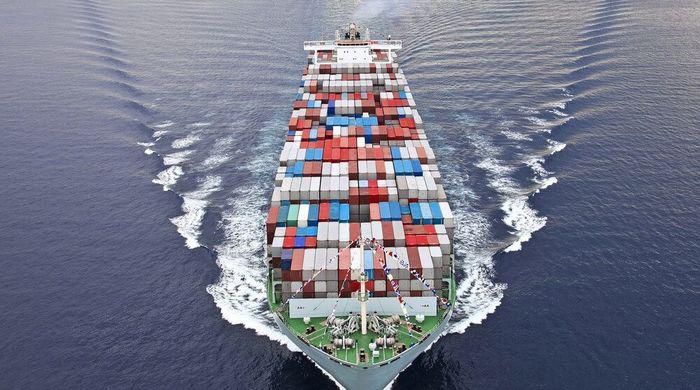

Transpacific spot rates declined for the first time in a month this week, as the threat of a US east and Gulf port strike vanished and the opportunity for pre-Chinese New Year (CNY) front-loading ended.
Meanwhile, significant price discounting continued to be seen on the Asia-Europe trades, with little hope of any recovery before CNY begins on 29 January.
According to Drewry’s latest World Container Index, spot rates on the Shanghai-Los Angeles leg dropped 5% week on week, to $5,228 per 40ft, while the Shanghai-New York leg declined 4% week on week, to $6,825 per 40ft, indicating that a series of general rate increases implemented on 15 January on the transpacific eastbound trade, ranging from $3,000 to $1,000 per 40ft, have yet to make an impact.
The WCI spot rates on both trades remain 35% and 21% up year on year, respectively.
Meanwhile, the recent rate weakness on Asia-North Europe and Asia-Mediterranean continued for another week, with the Shanghai-Rotterdam losing 3%, to finish on $4,231 per 40ft, a level 15% lower year on year.
The WCI’s Shanghai-Genoa leg declined 2% week on week, to $5,086 per 40ft, and is now 19% lower year on year, and forwarders on the trade now believe falling prices are likely to continue into February.
“We have seen a significant decrease in rate levels on FEWB of approximately $2,000 per 40ft from the levels we saw in December, and our expectation is that they will continue to drop post CNY,” one European forwarder told.
Xeneta head analyst Peter Sand told the market was also becoming more nuanced.
“Xeneta’s market average is at $4,488 per 40ft today – down a good $600 from year-end, and the declining trend set to continue; at the lower end of the market, we have rates at $2,777 per 40ft.
However, he also noted: “Especially during times like this, with substantial volatility, you can’t claim ‘the market is down by $2k in general’. But you can slice the market insights in a way that tells you ‘someone is out to catch you with some low rates on offer’.
“It’s clear that there are a number of lower offerings around – as the sub-average market is down by 20%-25% since the end of 2024, compared with market average spot freight rates that are down 12%.”
He said the major factors behind this were the alliance reshuffles, the Gaza ceasefire agreement, and rising overcapacity as a function of lower-than-expected demand.
“Can carriers correct this? November and December were extraordinary for Far East to North Europe and Med as the spot market rose,” said Mr Sand.
“We enter a weaker period of the year, a decline is happening – although still substantially above the end-October rates – but even a swift raft of blank sailings cannot turn the tide.”
The transatlantic continued to buck the east-west rate trend, however – with a transit time of one week between North Europe and North America there were still options for shippers to beat the Trump inauguration (Monday) deadline, when new tariffs could theoretically be announced.
The WCI’s Rotterdam-New York leg gained 4% week on week to $2,798 per 40ft, a rate that is 86% up year on year.


I use AI in my work and decided to reflect on the future of seamless logistics. Here's how AI envisions it





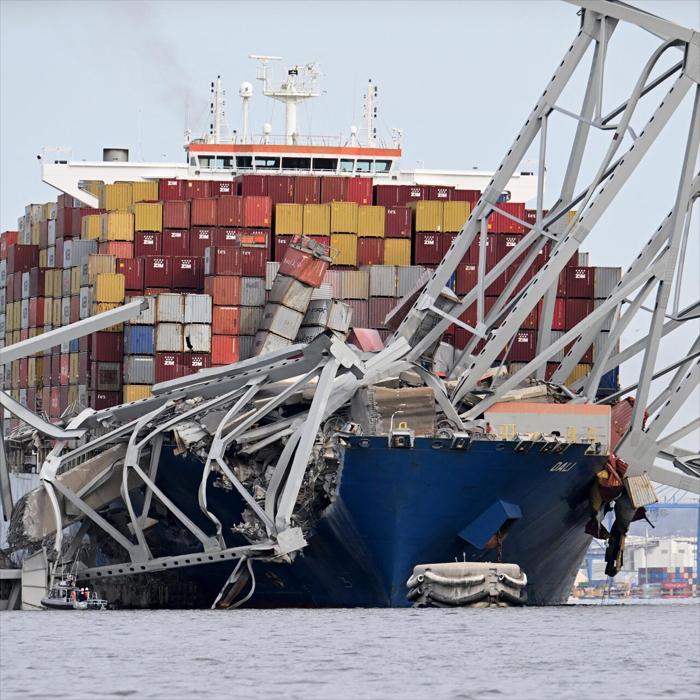
Dali, the container ship that knocked down the Francis Scott Key Bridge in Baltimore in March 2024, has resumed service after two months of repairs.
Vessel-tracking data showed that after a period of detention and salvage, Maersk-chartered Dali sailed to Subic Bay, Philippines, staying there between 4 and 6 November. The 2015-built, 9,962 TEU ship then moved to Luoyuan Bay Huadong Shipyard on 13 November, staying there for repairs until 14 January.
Dali has been assigned to Maersk’s AC3 Asia-Central America service.
On 26 March 2024, Dali allided with Francis Scott Key Bridge, reportedly after suffering a power outage. Six construction workers on the bridge were killed while two others were rescued from Patapsco River below. The ship was immobile for six months as parts of the collapsed bridge had to be lifted off the vessel.
As lawsuits from various parties, including Maryland state, mounted, Dali’s Singapore-based owner Grace Ocean Pte Ltd and ship manager Synergy Marine agreed to pay US$10 million to settle a civil suit brought by the US government.

US importers and their suppliers and logistics providers may face a scramble to react to the incoming US administration’s introduction of more tariffs, customs brokers warn.
President-elect Donald Trump’s determination to impose tariffs on US imports appears firm and their implementation could play out much faster than anticipated, said Adam Lewis, president of Clearit Customs Brokers.
“The timeline for implementation could be weeks,” he warned.
Until recently Mr Lewis shared the broad assessment that the threat of tariffs was largely a lever to force trade partners to negotiate, and that it would take months for tariffs to come into effect. However, a session of the National Customs Brokers and Forwarders Association of America (NCBFAA) on 7 January changed his perspective.
Citing sources from within the new administration, the NCBFAA warned that the tariffs threat was more than sabre rattling. Information it had pointed to plans for a tariff of 10% to 20% on virtually all imports, 60% on imports from China and 100% tariff on goods from any country that has abandoned the US dollar as the reserve currency.
“What we’re seeing now is more of a nuclear option. This is across the board,” added Mr Lewis.
He said Mr Trump may use special legislation to speed up implementation – the NCBFAA session indicated the International Emergency Economic Powers Act, which could bypass lengthy negotiations in Congress.
The 1977 legislation authorises the US president to interfere with international commerce after declaring a national emergency, in response to any unusual and extraordinary threat to the US that has its source, in whole or substantial part, outside the nation. It was first used by the Carter administration during the Iran hostage crisis.
Brandon Fried, executive director of the US Airforwarders Association (AfA), shares these concerns. He pointed out that the incoming president had a protectionist agenda during his first spell in the White House.
“I believe his rhetoric on tariffs has to be taken seriously. It’s reasonable to expect he’s going to take similar action, particularly on China and on partners he had disagreements with,” he said. “We agree with the NCBFAA and advise our members to take these promises seriously and be prepared.”
The AfA urges members to talk to customers about supply chain strategies and duty drawbacks and ensure they have the correct product definitions.
Manufacturers also have to take note, added Mr Fried.
“You should take action and review your supply chains. Identify where your goods are sourced from and have alternatives. And you should review how your goods are classified,” he said.
The AfA is opposed to tariffs, as they usually increase costs and likely prompt retaliatory actions that further impede trade, but “this is a speeding train. It’s not easy to get out of the way,” he said.
Strikes at ports on the US East Coast and Gulf Coast, which would have caused an economic and supply chain crisis, have been called off – with ocean container freight rate growth now expected to slow or fall.
The strikes were set to begin on 15 January and would have forced the closure of ports from Maine to Texas. This has now been averted after a tentative agreement over a new six-year master contract was reached between the International Longshoremen’s Association (ILA), which represents port workers, and the US Maritime Alliance (USMX).
Data from Xeneta – the ocean and air freight intelligence platform – shows average spot rates from the Far East to the US East Coast had already increased 26% since 14 December and were expected to rise further had the strikes gone ahead.
Emily Stausbøll, Xeneta Senior Shipping Analyst, stated: “The agreement between the ILA and USMX must be welcomed because a strike had the potential to be a supply chain and economic disaster, but it still highlights the difficulties facing shippers in managing supply chain risk.
“We have seen average spot rates on the trade from the Far East to US East Coast spike 26% since mid-December to stand at US$6,800 per FEU (40ft container), with carriers poised to add further disruption surcharges up to US$3,000 per FEU should the strike have gone ahead.
“It is extremely difficult for shippers to protect supply chains and manage freight spend with this level of uncertainty and when the stakes are so high.”
Stausbøll added that spot rates may now begin to fall – but shippers still face other supply chain threats in 2025.
She said: “Looking ahead, it is likely spot rate growth will now soften on trades into the US from the Far East, suggesting a brighter outlook for shippers negotiating new long term contracts.
“Signs of a weakening underlying global market in 2025 are also seen in falling average spot rates from the Far East to North Europe in January, which had spiked 51% between 31 October and 1 December last year.
“Shippers must remain cautious, however, because it will not take much for freight rates to begin spiralling once again, particularly given the ongoing conflict in the Red Sea and the return of Trump to the White House, which could escalate the US-China trade war.”

Forget being the Year of the Snake, 2025 will be “the year of the first major alliance-free carrier”.
The combined capacity of the liners controlling more than 1% of the global liner fleet grew by 10.3% last year, according to Alphaliner.
As the only carrier opting to go-it-alone with no alliance in 2025, MSC unsurprisingly showed the strongest growth, in terms of teu slots in 2024.
According to today’s Alphaliner newsletter, the Geneva-based carrier added 50 newbuilds and 692,000 teu slots to its fleet last year, which represents an above-market average growth of 12.3%.
Its current fleet capacity is 6.3m teu, widening the gap from world number-two operator Maersk, with its 4.4m teu, to 1.9m teu. Alphaliner data shows the Danish carrier grew its fleet last year by 7.3%, with 23 newbuildings.
Next month, Maersk will launch the Gemini Cooperation with Hapag-Lloyd, which operates a fleet with capacity of 2.3m teu, having expanded by 367,000 teu or 18.7% in 2024.
The analyst found that, in percentage terms, Hapag-Lloyd saw the third-largest fleet expansion among the top 12 carriers last year, after PIL at 29.9% and Zim at 26%.
On the other end of the spectrum, Evergreen’s 6.9% fleet growth was lower than the market average, having added 24 new vessels with 212,500 teu.
And, despite the carriers’ relentless search for more tonnage in 2024, market demand remains strong, and the threat of overcapacity still hasn’t surfaced, reflected in low vessel idling and charter availability.
Alpahaliner noted that the charter market was short on tonnage above 3,000 teu, with vessels of 5,500 teu and above “especially limited until the summer”.
This low availability of vessels, it warned, had the potential to create further rises in charter rates.
It also noted that the commercially idle containership fleet ended the year “with a downtick” from what was already a low number. And over the past fortnight, Alphaliner again recorded “a reduction in carrier-controlled vessel idling”. In its latest survey, on 30 December, it recorded 58 ships, or 173,930 teu, as commercially idle.
It reported: “At only 0.6% of the total cellular fleet, the liner sector can still be considered ‘fully employed’, and there is zero structural idling.”
And the analyst warned that the upcoming alliance reshuffle was expected to further exacerbate demand for tonnage in the short-term because carriers would “require some extra tonnage as a ‘buffer’ until vessels gradually settle into their new network setups”.
However, it concluded that how 2025 would ultimately unfold for capacity demand would “very much depend on geopolitics, with the key question being to know when the Red Sea crisis will end”.
It explained: “An early reopening of the Suez route could derail the current bonanza for shipowners and carriers, with a likely return of overcapacity hitting particularly the largest ships.
“The threat is all the more plausible as another 2m teu of newbuilding capacity is expected to be delivered in 2025,” it added.

The impending network changes made by the big container lines look set to ensure continuation of services around the Cape of Good Hope until the latter half of 2025.
CEO and partner at Vespucci Maritime Lars Jensen told resumption of services through the Suez Canal would involve further network changes, and he questioned whether carriers would be willing to make these before August, “at least”.
“Shipping lines are set to phase-in their new networks over the course of February and March, and this means reliability during this period will be all over the place,” he said.
“However, the moment they decide to go through the Red Sea again, they will have to change their networks, I do not see a scenario in which they are going to be happy, having done this in February, to be required to do it again in April or May.”
Mr Jensen speculated that even if the Red Sea Crisis was resolved, the diversion of ships around the Cape would likely remain in place for a further six months.
Pointing to Maersk’s early response to attacks on commercial shipping by the Iran-backed Yemen-based Houthi militia, he also said the carriers “had learned” from the “extreme disruption” brought about by the Danish carrier’s u-turns on using the Red Sea.
“If you call it too early, you have to revert and this becomes extremely disruptive, so for carriers, there is little impetus to go through Suez just yet,” he added.
Furthermore, Mr Jensen said, shippers were equally hesitant about “jumping the gun”, favouring the stability of the longer transits to potential disruption, noting that the response to CMA CGM’s planned new Suez service typified shippers’ mindsets.
“CMA CGM has been offering an Asia-Mediterranean service operating through the canal, escorted by naval vessels, and announced a new service running to the US,” he said. “But customers baulked, telling the carrier they did not want their goods going through the Red Sea.
“For shippers, the concern is not that the Africa route takes longer, nor that they may lose their cargo if a ship is attacked, the concern is general average (GA).”
Mr Jensen explained that if a ship was attacked by Houthis, it could catch fire and leak fuel into the sea, leading to “an expensive clean-up” and a likely declaration of GA.
While shipper insurance would potentially cover this under normal circumstances, given the known threat in the Red Sea, Mr Jensen said, “insurance would not cover GA in a risky area”, even regardless of naval protection on offer, in the case of CMA CGM.
But Mr Jensen added: “When it becomes clear that there is no more risk, competitive pressures will prompt one carrier to start using Suez again, and then they will all follow suit, because it will be quicker and cheaper for shippers.”
