
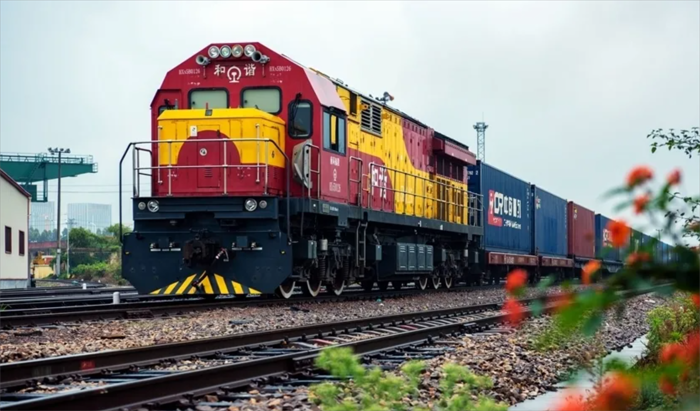
The Xi’an Guojigang Railway Station in Xi’an, northwest China’s Shaanxi province, is the railway station that sees the most trips made by China-Europe freight trains across China. It is designed to handle 5.4 million twenty-foot equivalent units (TEUs) and transport 66 million tons of cargo via railway each year.
Since the China-Europe freight train (Xi’an) service was launched in 2013, Xi’an has handled over 20,000 China-Europe freight trains, or about a quarter of China’s total. It operated more than 5,000 China-Europe freight trains in 2023 alone.
Today, Xi’an Guojigang Railway Station operates 18 regular international westward routes that reach Almaty in Kazakhstan, Tashkent in Uzbekistan and Hamburg in Germany and cross the Caspian Sea, covering the entire Eurasian continent and connecting Xi’an to major international trade hubs.
The station also operates scheduled rail-sea intermodal services to Qingdao, Ningbo and Lianyungang in the east, and freight services to Vietnam and Laos in the south.
Currently, Xi’an Guojigang Railway Station serves as a distribution hub for freight from more than 20 provinces across China, as 21 rail routes to Western Europe pass through it.
“Although Xi’an isn’t on the border or the coast, you can see the whole world from here,” says Li Pei, a duty manager at the station.
According to Shao Bo’er, general manager of Xi’an International Inland Port Multimodal Transportation Co., Ltd., which operates the China-Europe freight train (Xi’an) service, the company’s business volume increased by 1.5 times year-on-year in the first two months of this year.
The company has gained major domestic enterprises like Sany Heavy Industry and LiuGong as new clients, as well as multinational corporations such as Volkswagen, Shao said. Even consigners from Japan and South Korea would take Xi’an as a transfer hub for their goods to Europe, Shao added.
In July 2023, the station upgraded its service to a “2.0 version” – with two outbound and one inbound full-time schedule trains per week.

Learn more about Maxmodal advanced features for your business


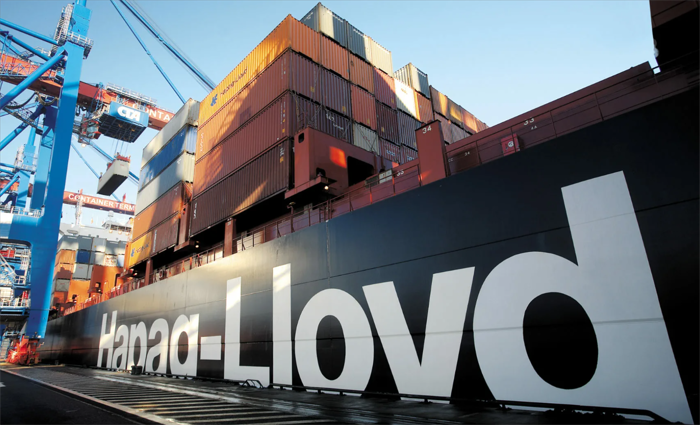
THE Alliance is to continue the suspension of its Asia-North America east coast EC4 service, reversing a decision to relaunch this month.
“THE Alliance members – Hapag-Lloyd, ONE, HMM, Yang Ming – will postpone the resumption of the Asia-US east coast via Suez EC4 service until the situation in the Red Sea stabilises further,” liner Alphaliner wrote today in its weekly report.
“The EC4 had been suspended in November due to poor market conditions, and its re-launch was originally planned for mid-April,” it added.
The liner shipping analyst explained that the vessels due to be deployed on the EC4 would be assigned to the alliance’s three remaining Asia-US east coast services – EC1, EC2 and EC5 – which would all be expanded to feature additional port calls.
The EC1, which transited the Suez Canal but now sails via the Cape of Good Hope, is to make an additional call at Xiamen on its head-haul ex-Asia leg. EC2, going via the Panama Canal, will also feature an additional Asia outbound call, at the southern Chinese hub of Yantian.
Meanwhile, the EC5 service, which connects South-east Asia with the US east coast and has no Chinese ports in its rotation, will add a call at Charleston and a second call at New York on its backhaul leg.
The continuing disruption, caused by Houthi attacks, is in danger of becoming a de facto blockade of the Suez Canal, and has also hit the scheduling plans of alliance member ONE, which is set to launch a standalone service between India and the US east coast.
Due to begin next month, the WIN service will postpone both head-haul and backhaul calls at the Egyptian transhipment hub of Damietta, the head-haul call at Algeciras and the backhaul call at Jeddah while its vessels have to transit the Cape of Good Hope.

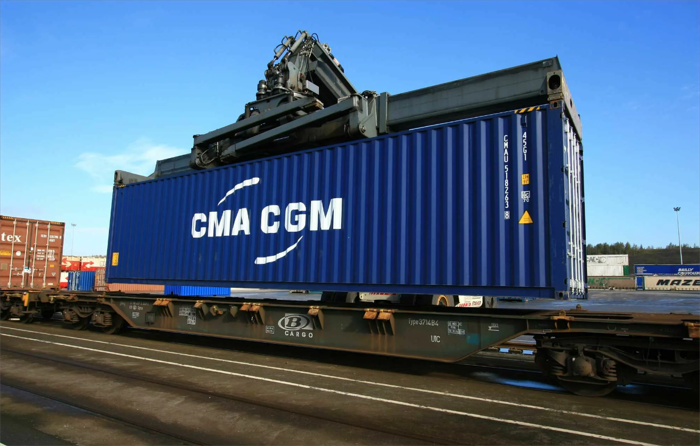
French shipping giant CMA CGM and Italian rail freight operator GTS Rail are establishing a new joint venture (JV) called European Container Network to take their collaboration to an international level. The two companies are already cooperating in Italy, especially from the port of Genoa.

Container shipping is responsible for moving 90% of the world’s goods, according to the World Economic Forum. But, if shipping containers aren’t at the right place at the right time, the global supply chain may face serious problems. It could result in high inflation, shortages of key materials and products as well as revenue losses to large and small businesses alike. At the same time, over 95% of shipping container manufacturing is happening in the nation that leads the world in exports — China, according to the Federal Maritime Commission. Here’s how shipping containers can save, or cripple, the global economy.


Baltimore's major shipping hub us now out of commission for what could be months


During the fourth quarter of 2023, the shipping lines collectively reported a combined EBIT loss of US$1.44 billion. Among the major players, Maersk recorded a loss of US$920 million, followed by Hapag-Lloyd (US$252 million), ONE (US$248 million), Yang Ming (US$ 109 million), ZIM (US$54 million), and Wan Hai (US$41 million).
Comparing these figures across the same set of shipping lines (excluding ONE due to limited historical data), and incorporating Evergreen and HMM, both of which achieved operating profits in 2023-Q4, this quarter marked the highest combined EBIT loss from 2012 to 2023. The previous record was in 2015-Q4, with a loss of US$455 million.
To analyze profitability per TEU shipped, Figure 1 illustrates the EBIT/TEU trends from 2010 to 2023, highlighting the unprecedented levels observed during the 2021-2022 pandemic period. Figure 2 focusses on the developments in 2023, cutting off the y-axis at +/- 300 USD/TEU for clarity.
Eight people were believed to have been on the Baltimore bridge when the massive container ship smashed into it in the early hours. Most of the 1.6-mile-long structure collapsed in seconds - sending those on it plunging into the river below

Get more benefits with maxmodal for your business