
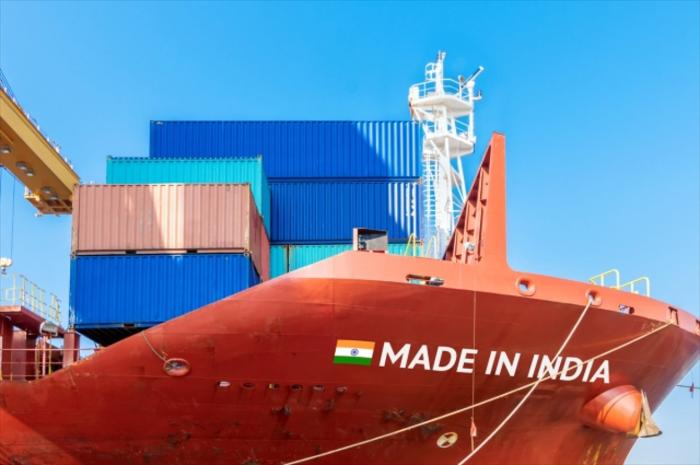
India is attempting to “play hardball” to become an alternative shipbuilding market, amid the trade diversification that has already yielded it some tangible gains on electronics manufacturing.
New Delhi’s latest federal budget, for fiscal year 2025-26, presented on Saturday, announced a host of measures to encourage investment in shipbuilding.
They include government approving a proposal to develop mega-shipbuilding clusters in the country, and earmarking some $700m to help existing yards enhance their infrastructure.
The government has also extended a “shipbuilding financial assistance policy,” aimed at providing direct financial subsidies to Indian shipyards, with a higher allocation of some $2bn. This is meant to help Indian companies offset operational cost disadvantages while seeking to secure shipbuilding orders.
Additionally, basic customs duty exemptions on the import of shipbuilding materials have been extended for 10 years.
Shipping minister Sarbananda Sonowal said: “India’s maritime sector has witnessed significant progress since 2014, and with the latest announcements, we are confident that the shipbuilding industry will serve as a catalyst for economic growth.
“This holistic approach will not only support industry growth, but also position India as a global leader in shipbuilding and maritime innovation.”
In another significant move, India has approved setting up a mammoth $3bn Maritime Development Fund (MDF) to provide financing for ship acquisitions, in a bid to boost its sagging fleet presence in the ocean trade ecosystem. The government plans to contribute 49%, with the remainder coming from major port authorities and other public sector enterprises, as well as from the private sector.
The government believes the MDF could lay the path to boost the share of Indian flagged-ships in the global cargo sphere up to 20% by 2047, believing an “indigenous fleet will reduce dependability of foreign ships, improve balance of payment and secure strategic interests of the country”.
Shipping Corporation of India (SCI), India’s only long-haul operator, recently indicated plans to acquire more containerships to raise its service network profile, ostensibly responding to growing shipper concerns over high freight charges by foreign container lines which have a near-monopoly in the market.
Other notable takeaways from the 2025-26 budget included an extension of the tonnage tax scheme to vessels used on the inland waterway network, an incentive thus far only available for ocean-going ships.
Indian shipping industry stakeholders across the spectrum have welcomed the proposals, while continuing to push for further policy refinements.
“The MDF is a game-changer, signalling the government’s serious intent to make India a global hub for shipbuilding,” Vivek Merchant told (director at Swan Defence and Heavy Industries).
“The industry still needs policy reforms that encourage private sector participation and reduce dependency on imports for critical components,” he added.
Rizwan Soomar, DP World’s CEO and MD for the Middle East/North Africa/India Subcontinent, believes India has the potential to solidify its local production prowess with ongoing infrastructure development and policy reforms. Through shortsea shipping subsidiary Unifeeder, it has expanded its interests beyond terminal operations.
“The government’s commitment to inland water transport through the tonnage tax scheme will provide a more sustainable and cost-effective way of cargo movement,” said Mr Soomar.
Shashi Kiran Shetty, chairman of Mumbai-based cargo consol leader Allcargo Group, said while the new budget plans underscored a stronger intent to position India as a shipbuilding nation, it would require much more to catch up with global giants in the field, especially China.

Shippers are happy to pay more for capacity and pricing assurance, and would like to be “in the loop” with supply chain decision-making, delegates heard at this week’s World Cargo Summit in Bruges.
Jody Paulus, CEO of dangerous goods shipper Optitune, explained that as a seller, he must set prices and quantities for his clients around a year in advance of production – which creates a headache when factoring-in supply chain costs.
He told delegates” “What is very important for me is that I have to make my prices at least a year in advance, with shipment included. It’s very difficult to get some kind of price [from carriers or forwarders], yet I must deal with this in my price towards my client.
“I am not completely sure what I’m actually going to pay for a certain shipment at a certain time. The more insecurity, the less interesting it is to me.”
And Mr Paulus said he would be happy to pay top dollar for a reliable service.
“When we talk about profitability, for me, it might almost be worth it to pay a little bit more and have a guaranteed price and guaranteed availability that I can ship, rather than think it’s always the lowest possible price.”
Further, Mr Paulus said, shippers looked for a “customer-centric” supplier that would take care of unexpected changes to their supply chain.
“Treat me as a partner,” he said. “Think along with me, if you can. For instance, now I’m not only shipping to China, suddenly I’m shipping to Vietnam. That’s now two destinations, because of geopolitics and production changing. This means completely different requirements and documents.
“Who can help me with this, so that I know that my shipment really arrives? I’m looking, of course, at my partner. This is where I hope they say, ‘oh, we can do everything for you’. They can say, ‘but it will cost you a little bit more’, but at least I know that it will be done.”
Danita Waterfall-Brizzi, principal cargo and logistics consultant at Hospitio, pointed out that forwarders shouldn’t assume that their customer “knows as much as they do about moving freight”, and there was often no explanation or discussion about the options and challenges of going from A to B.
“If they actually know that we have to have ‘China plus one’, we have new ways of shipping… As a shipper, it sounds like you wouldn’t mind knowing some of those things,” she told Mr Paulus
“Not to do it on your own, but to understand the challenges, the timing, and then the pricing that’s involved.”
He agreed that “that kind of information for me would be crucial”, adding: “We all know the better the relationship you have with your client, the less likely they are to shop around for something else.
“If I have security that they are getting me there every single time, no problems, at a price I know and can accept, then I have very, very little incentive to look for something else.”
Ms Waterfall-Brizzi said freight forwarders “more than ever” had their work cut out to manage supply chains in a turbulent world and stay competitive.
“Being able to explain and work through regulations for countries, the customs needs, what paperwork, what is digitised and what’s not, would help,” she concluded.

Vietnam is gaining ground as an alternative to China, but there are warnings that too-rapid growth could provoke tariffs from the new US administration.
Speaking to the Freight Buyers’ Club podcast, Tektronik Industries’ VP for global logistics, Alan Mctaggart, said that in 2018 the company began moving some of its manufacturing base into the South-east Asian country during the previous Trump government.
He said despite China having been a “easy, easy, easy” country in which to operate, Vietnam had also become “a productive place” for the company and was working well.
Tektronik’s move south was precipitated by the more hostile approach to China Mr Trump’s first administration brought into the White House, an approach continued, albeit with calmer rhetoric, by President Biden.
Since 2016, Vietnam has made sizeable strides in manufacturing output and now finds itself below just China and Mexico in terms of its trade surplus with the US.
And Mr Mctaggart said he could see further growth for the country, noting that he expects outsourcing to continue, especially if China is hit with particularly high tariffs.
While this may prompt optimism for the South-east Asian countries that have been lining up as replacements for China, there are voices of caution in Vietnam.
One source told the Trump administration appeared more focused on trade deficits this time around, than what they largely considered to be his previous more sinophobic stance.
Consequently, referencing the huge trade deficit between the US and Vietnam, they said it was likely Vietnam, if not already in the US crosshairs, was certainly being scoped.
Drewry Shipping Consultants’ MD and head of its supply chain advisors, Philip Dammas, told Freight Buyers Club it was not impossible that Mr Trump would impose tariffs on the US’s three biggest suppliers – China, Mexico, and Vietnam.
However, he added that the early signs indicated that the “huge trade war” talked-up during the election campaign may be avoided.
“Based on the data today, it looks as if it’s going to be a bit more targeted and less disruptive for carriers and forwarders and shippers. So, we stick with our previous forecast that there will be a slow increase in demand this year,” said Mr Dammas.


The Chinese factory rush to get goods out before the new year holiday, and the threat of US import tariffs, have seen global container port congestion hit a three-month high.
Approximately 3.3m teu, or nearly 11% of the container shipping fleet, is held up at ports in Asia, Europe and North America, according to a Linerlytica report today.
The consultancy said: “Chinese ports are extremely congested in the run-up to the holidays, with both the Yangtze River ports and Pearl River Delta ports recording a significant surge in gate and berth congestion. The pre-holiday cargo rush has been exacerbated by heavy demand to beat potential US tariffs for Chinese imports, with carriers also scrambling to build cargo roll pools ahead of the holiday lull.”
Linerlytica said the congestion in China would disrupt the transition to the new container shipping alliances on 1 February, giving breathing space to mainline operators that are bracing for under-utilisation after Chinese New Year, which starts tomorrow.
The southern port of Yantian, which processes one-third of Guangdong’s international trade and 25% of China’s exports to the US, upped its daily cap on container handling by 15%, to 15,000 units in the past eight days, it said last week.
In 2024, Yantian’s container volumes increased nearly 7% year on year, to a record 17.37m teu, in tandem with the 15% jump in neighbouring Shenzhen’s exports to a new all-time high of CNY2.81trn ($384.93bn).
Severe weather at both the US Atlantic coast and around the English Channel has also impacted vessel movements and held up ships heading to and from the US east coast and northern Europe. UK ports were especially affected, with Felixstowe, Southampton and London Gateway all forced to shut, with weather warnings persisting through this week. Furthermore, workers in French ports and at ECT Rotterdam have started industrial action, slowing operations.
The implementation of tariffs on US imports from China remains unclear. Shortly after Donald Trump’s election win in November, he talked about levying a 60% tariff on imports from China. However, after his inauguration on 20 January, President Trump said a 10% tariff could be imposed from 1 February.
Then, in an interview with Fox News on 23 January, he said tariffs might not be executed after all, with the China’s Ministry of Commerce urging dialogue and consultation to resolve issues between the two countries.

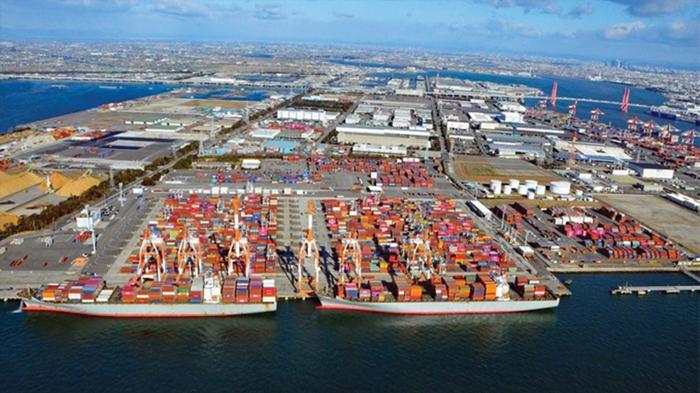
Container movements from Japan to the United States reached a total of 643,433 TEUs in 2024, marking a 5.7% increase compared to the previous year.
In addition, direct shipments accounted for 445,147 TEUs, reflecting a significant 13.8% growth, while transshipped containers totalled 198,286 TEUs, translating to a 9% decline.
Focusing on direct shipments, Tokyo contributed 182,538 TEUs, up 8.9%; Nagoya handled 129,529 TEUs, up 17.4%; Kobe recorded 91,380 TEUs, up 11.1%; Yokohama shipped
30,715 TEUs, up 27.6%; and Shimizu moved 3,964 TEUs, down 18.8%.
In December 2024 alone, container shipments from Japan to the United States reached 48,739 TEUs, a modest year-on-year increase of 0.1%, marking three consecutive months of growth. Direct shipments improved 2.1% to 34,264 TEUs, while transshipped containers declined 4.4% to 14,475 TEUs, making up 29.7% of the monthly total.
By port of origin in December, Tokyo shipped 14,096 TEUs, a 2.6% decrease; Nagoya handled 9,902 TEUs, up 3.1%; Kobe moved 6,980 TEUs, up 7.8%; Yokohama recorded 2,428 TEUS, an 18.8% increase; and Shimizu shipped 347 TEUs, down 15.2%.
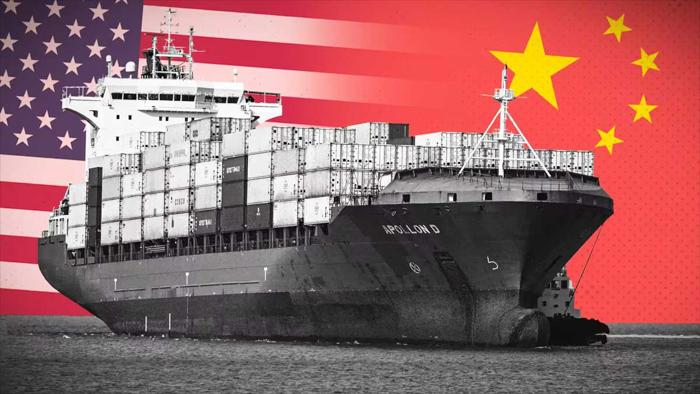
US shipbuilding ambitions have observers scratching their heads on the viability, funds required, and their likely provenance, as well as potential repercussions for cargo owners and logistics providers.
The US is moving closer to a grand push to revive its shipbuilding industry. The report on a probe into unfair practices in Chinese shipbuilding, released last week, is providing fresh ammunition for supporters of the Shipbuilding and Harbor Infrastructure for Prosperity and Security for America Act, a bipartisan legislative proposal introduced to Congress on 19 December.
The probe, launched last April, concluded that China had used unfair policies and practices to dominate global maritime, logistics and shipbuilding sectors, with measures ranging from state financial support to intellectual property theft and forced technology transfer.
Vessels built in China accounted for more 50% of the global activity in this sector in 2023, while US shipbuilding activity has shrunk since the end of World War II, when 80 firms were producing ships, to 20 today.
For decades, vessel owners, like virtually everybody else, were happy to procure from the source offering the lowest cost – China, said Lars Jensen, CEO of shipping consultancy Vespucci Maritime. Now the US is looking at the issue through the lens of national security, as it lacks a sufficiently large fleet of US-flagged support vessels for the navy, he explained.
Marine investors are already in high spirits. At Marine Money’s annual conference in New Orleans in November, the mood was upbeat in expectation of a promised resumption of offshore drilling that would boost demand for support vessels. The SHIPS Act promises further momentum.
The proposed legislation calls for the production of 250 US-built ships within 10 years. The authors of the bill have not provided a breakdown of vessel requirement by category; the scope appears to be quite broad.
“They pour this over everything, including container shipping,” Mr Jensen noted.
To inject money into US shipbuilding, the legislation calls for the establishment of a Maritime Security Trust Fund to funnel $250m a year to US shipyards and proposes an incentives programme centred around a 25% investment tax credit.
However, observers do not think that this will suffice. By some estimates, revitalising the US shipbuilding industry would require tens of billions of dollars.
Not surprisingly, the new administration is looking to raise some money from Chinese-built vessels calling at US ports. But Mr Jensen has reservations: for one thing, carrier alliances could switch vessels to avoid a US ship charge, he pointed out.
Additional money could come from fines levied on cargo owners that fail to meet the provision in the legislation that 10% of commercial goods imported from China would have to move aboard US-flagged vessels, starting in 2029. But implementing this would be “extraordinarily problematic”, warned Mr Jensen.
And US legislators may want to extend that provision to goods made in South-east Asia with China-produced components, perhaps by offshoots of Chinese manufacturers, to close some loopholes. But this would require adequate US vessel capacity out of those origins as well.
At this point it is unclear if the demand on cargo owners to move 10% of their US-bound traffic from China on US-flagged vessels would also apply to forwarders and other logistics providers.
The SHIPS Act envisages a transition period, until 2029, during which foreign-built ships could be re-flagged with the stipulation that they be replaced with US-made vessels as soon as they become available.
Some observers see a promising opportunity for South Korean shipyards to become involved, noting that some of these have collaborated with the US Navy, on the overhaul of support ships, and with US shipyards to design US commercial vessels. Last summer. Hyundai Heavy Industries signed an MoU with the universities in Seoul and Michigan to set up a shipbuilding design and engineering exchange programme to train US workers.
Given the vast difference in ship production costs in the US and China, it is unclear how attractive US-built vessels would be unless operators saw significant financial incentives. Mr Jensen sees only one way that the US could achieve a shipbuilding programme of the magnitude envisaged by the SHIPS Act: through massive subsidies.
Chinese academics responded to news of the proposed legislation by suggesting to Chinese financial news outlet Yicai that the US has limited capacity to build ships and is not competitive, vis-à-vis Asian countries.
If passed into law, the act could result in higher logistics costs and shipping route adjustments, one argued, adding that US importers might look for alternative transport solutions to counter elevated costs.
US President Donald Trump says in his inauguration speech that he will take back the Panama Canal.
Panama gained full control of the canal in 1999. Prior to that, Panama and the US had jointly operated the canal.
In his speech, Trump claims that China has increased its control over the canal.
“We didn’t give it to China. We gave it to Panama. And we’re taking it back,” Trump says in the speech.
The Panama Canal is a man-made lock canal that allows ships to cross through Central America from the Atlantic to the Pacific and vice versa.
If the canal didn’t exist, ships would be forced to sail around the tip of South America.
The United States largely built the Panama Canal in the early 1900s, and the US managed the area around the canal for decades.
In 1977, the US and Panama signed an agreement that paved the way for control of the canal to pass completely to Panama.
Trump has repeatedly expressed his desire for the US to regain control of the Panama Canal. He has also reiterated his desire for Greenland to become part of the US.
Panamanian President Jose Raul Mulino says the Panama Canal “is and will continue to be Panamanian”.
He said this in a statement on X, reports Reuters.
Trump does not mention Greenland during his inauguration speech on Monday.
However, he has previously said that he will not rule out use of economic or military force to gain control of the Panama Canal and Greenland.
“No, I can’t promise anything in relation to those two, but I can say this: We need them for our economic security,” Trump said in a press conference on Jan. 7.
He has also said that he is considering imposing a special tariff on Danish goods if Denmark does not agree to sell Greenland to the US.
Since then, Danish Prime Minister Mette Frederiksen has had a 45-minute telephone conversation with Trump.
After the talk, Frederiksen said that Trump has not withdrawn his threat of punitive tariffs on Danish goods.
“It has been suggested by the US that a situation could unfortunately arise where we work less together than we do today in the economic area. This is not something we recommend in any way, shape or form,” said Frederiksen after a meeting with the Danish Foreign Policy Committee on Thursday.
Trump has accused Panama of demanding excessive tariffs from US ships sailing through the canal. He has also claimed that Chinese soldiers control the waterway.
Mulino has emphasized that the Panama Canal belongs to Panama and that the country’s sovereignty is not up for discussion.
English edit by Daniel Frank Christensen

Why China?
Ocean container teu-mile trade grew 18% year on year in 2024, to 1,171 teu per mile, mainly due to vessel detours to avoid the Red Sea , according to a Clarksons report.
Container teu-mile trade is a measure of the volume of goods transported in boxes, and is often used to analyse global trade patterns.
Front-loading to avoid potential disruptions to the traditional peak period, also caused an early peak season, wrote Clarksons analyst Trevor Crowe.
Global container trade grew 5%, to 211.6 million teu, helping to support shipping demand.
Mr Crowe wrote: “Approximately 700 vessels were re-routing via the Cape of Good Hope for most of 2024, generating a 12% ‘distance kicker’ which supported an impressive 18% growth in teu-mile container trade.
“Underlying teu trade volume growth was also supportive, with a healthy rebound on the key mainlane routes and firm growth between Asia and developing economies. Container port congestion, often a knock-on impact from Red Sea disruption, also impacted, with various “hotspots” at times tying up as much as 4% of fleet capacity.”
Looking ahead, the Gaza ceasefire could usher in overcapacity. Based on expected fleet growth of 5% this year, a resumption of Red Sea transits could cause demand for container shipping to dip by 4%, as opposed to demand growth of 3% if Cape of Good Hope detours continue.
Clarksons has calculated that teu-mile trade could drop by 8% this year if containerships resumed all Red Sea crossings.
Currently, at least 85% of Far East-Europe container routes have been diverted to the Cape of Good Hope, while up to 90% of other container trades have also been rerouted. Clarksons however, believes that there will not be an overnight return to the Red Sea, as shipping schedules take time to rework.
The shipbroking group said: “There remains a range of factors at play that could delay any changes, including the reaction and next steps of the Houthis, safety considerations, fuel cost dynamics and arbitrage opportunities, and the extent to which concerns around the development of overcapacity in some segments could temper an immediate demand to return to ‘normal’ routing patterns.
“Any increase in transits would also take time to develop and vary by segment, if and when the safety situation evolves, and as liner companies for example, work through adjusting service schedules.”
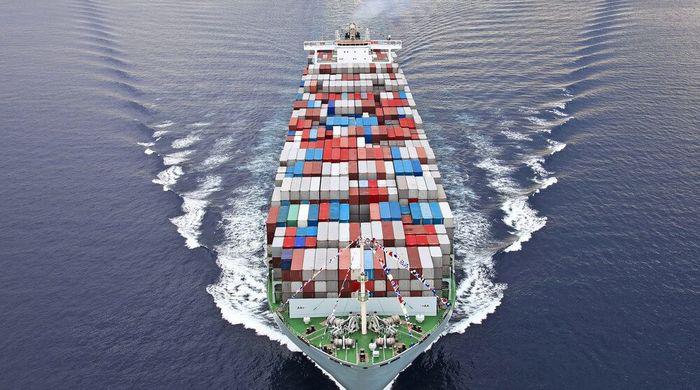
Transpacific spot rates declined for the first time in a month this week, as the threat of a US east and Gulf port strike vanished and the opportunity for pre-Chinese New Year (CNY) front-loading ended.
Meanwhile, significant price discounting continued to be seen on the Asia-Europe trades, with little hope of any recovery before CNY begins on 29 January.
According to Drewry’s latest World Container Index, spot rates on the Shanghai-Los Angeles leg dropped 5% week on week, to $5,228 per 40ft, while the Shanghai-New York leg declined 4% week on week, to $6,825 per 40ft, indicating that a series of general rate increases implemented on 15 January on the transpacific eastbound trade, ranging from $3,000 to $1,000 per 40ft, have yet to make an impact.
The WCI spot rates on both trades remain 35% and 21% up year on year, respectively.
Meanwhile, the recent rate weakness on Asia-North Europe and Asia-Mediterranean continued for another week, with the Shanghai-Rotterdam losing 3%, to finish on $4,231 per 40ft, a level 15% lower year on year.
The WCI’s Shanghai-Genoa leg declined 2% week on week, to $5,086 per 40ft, and is now 19% lower year on year, and forwarders on the trade now believe falling prices are likely to continue into February.
“We have seen a significant decrease in rate levels on FEWB of approximately $2,000 per 40ft from the levels we saw in December, and our expectation is that they will continue to drop post CNY,” one European forwarder told.
Xeneta head analyst Peter Sand told the market was also becoming more nuanced.
“Xeneta’s market average is at $4,488 per 40ft today – down a good $600 from year-end, and the declining trend set to continue; at the lower end of the market, we have rates at $2,777 per 40ft.
However, he also noted: “Especially during times like this, with substantial volatility, you can’t claim ‘the market is down by $2k in general’. But you can slice the market insights in a way that tells you ‘someone is out to catch you with some low rates on offer’.
“It’s clear that there are a number of lower offerings around – as the sub-average market is down by 20%-25% since the end of 2024, compared with market average spot freight rates that are down 12%.”
He said the major factors behind this were the alliance reshuffles, the Gaza ceasefire agreement, and rising overcapacity as a function of lower-than-expected demand.
“Can carriers correct this? November and December were extraordinary for Far East to North Europe and Med as the spot market rose,” said Mr Sand.
“We enter a weaker period of the year, a decline is happening – although still substantially above the end-October rates – but even a swift raft of blank sailings cannot turn the tide.”
The transatlantic continued to buck the east-west rate trend, however – with a transit time of one week between North Europe and North America there were still options for shippers to beat the Trump inauguration (Monday) deadline, when new tariffs could theoretically be announced.
The WCI’s Rotterdam-New York leg gained 4% week on week to $2,798 per 40ft, a rate that is 86% up year on year.


I use AI in my work and decided to reflect on the future of seamless logistics. Here's how AI envisions it