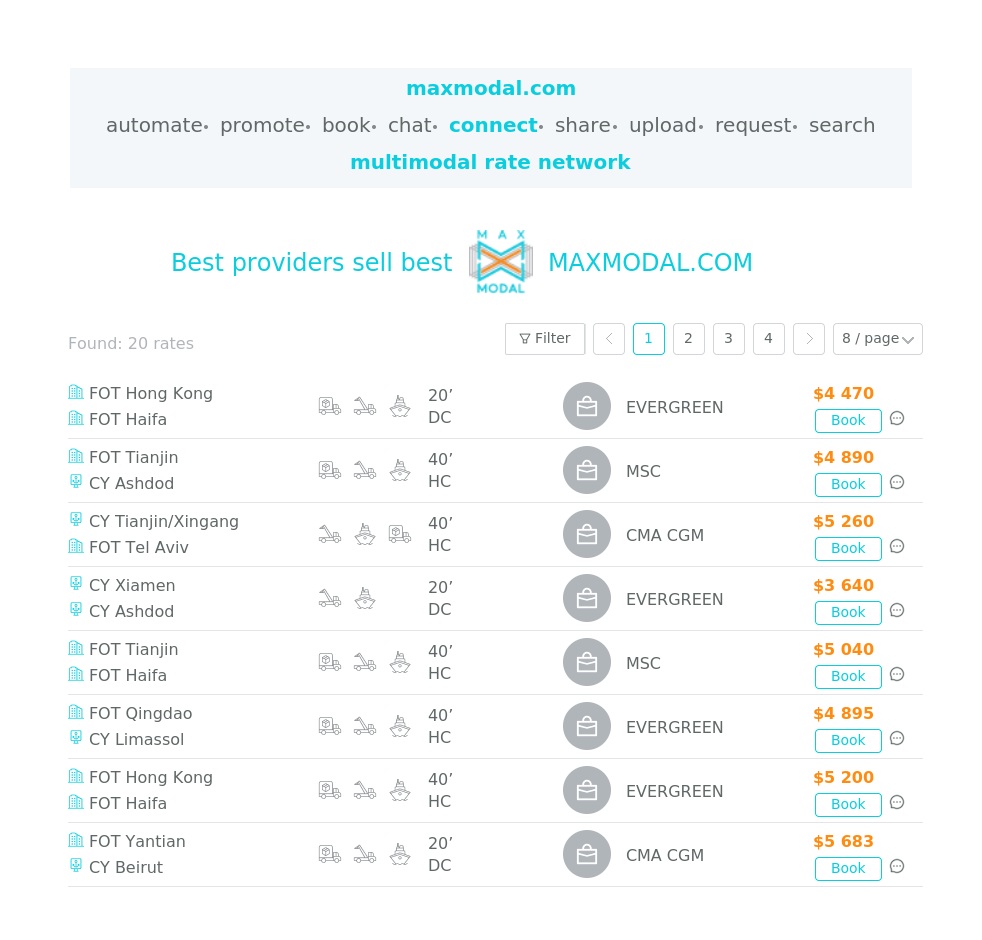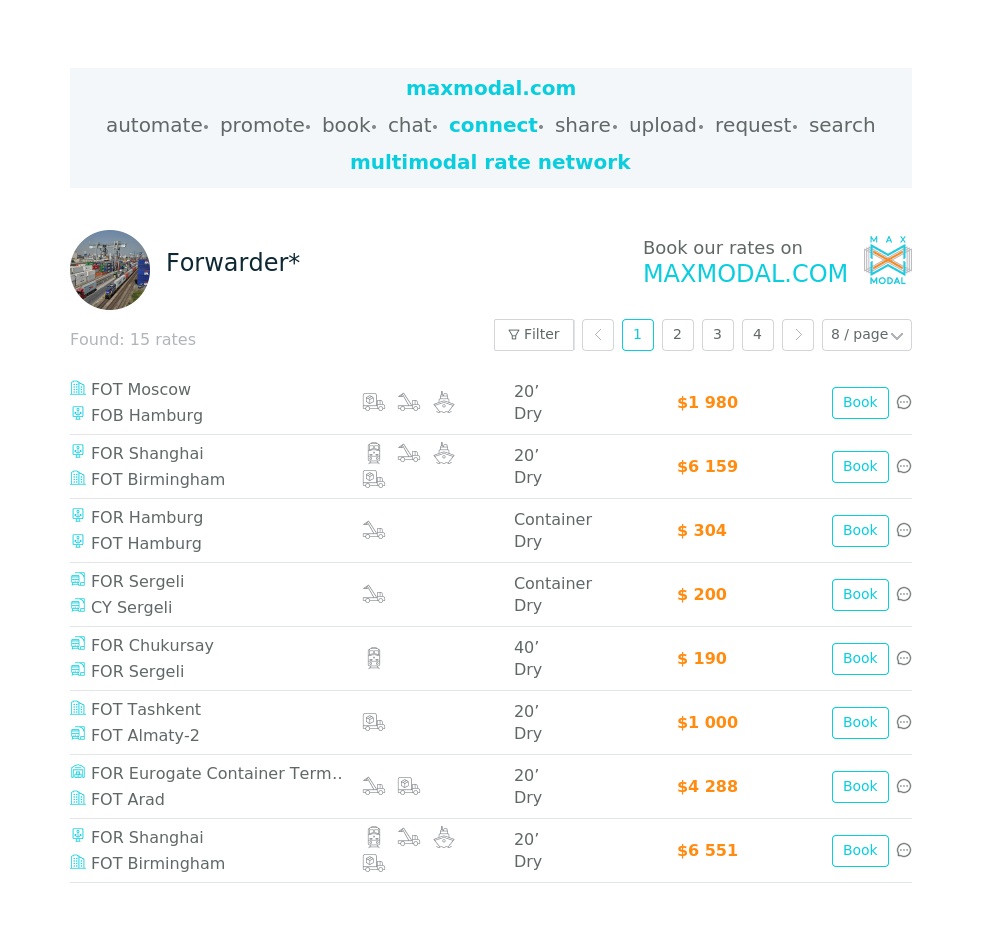

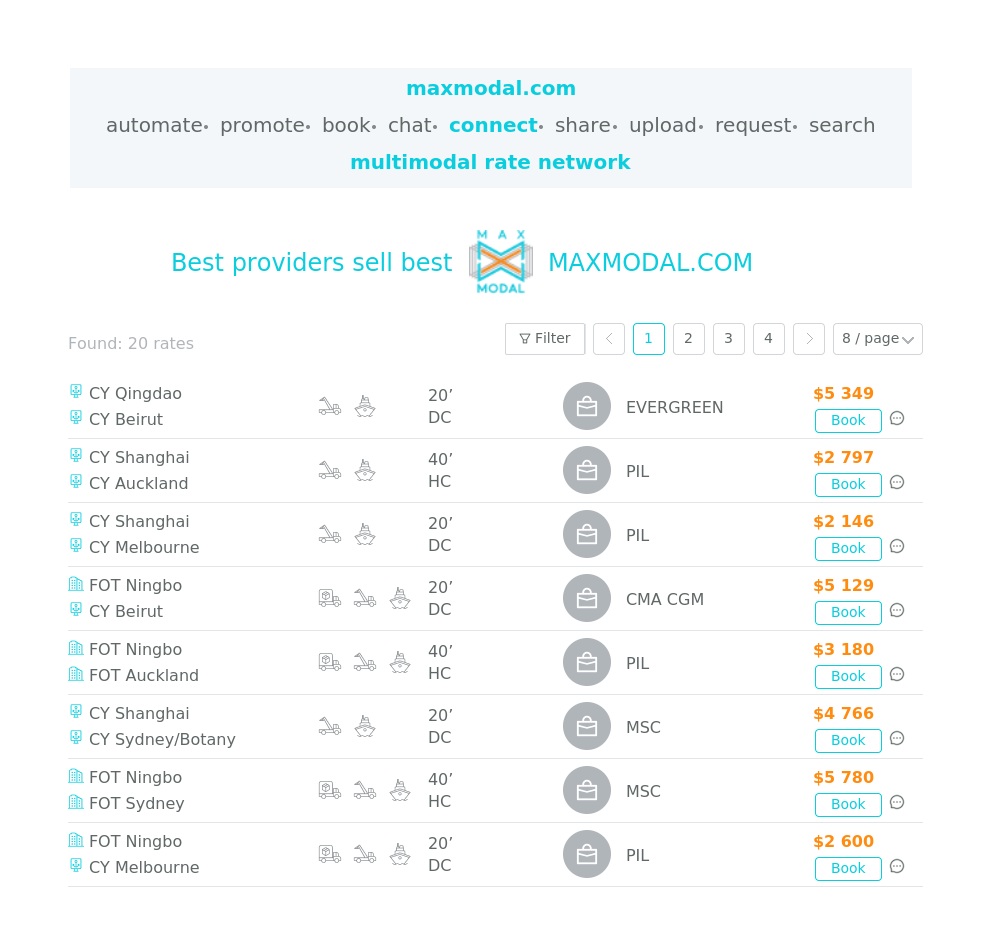
Get the link for freight rates by many providers on maxmodal.com
Transpacific container rates to the West Coast doubled last week on June 1st GRIs to
US$5,488/FEU, with the latest daily rates above US$6000/FEU as shippers start peak season early and frontload goods ahead of tariff pause expirations in July and August.
Prices to the East Coast climbed 60% to US$6,410/FEU with the latest daily rates aboveUS$7,000/FEU, with rates on both lanes about even with levels a year ago when Red Sea-driven capacity restraints combined with an early peak season rush ahead of the ILA port strike threat to push prices up.
Carriers are planning additional transpacific GRIs of US$1,000 - US$3,000/FEU for mid-June and again on July 1st. China's ports are likely still working through some of the backlog of ready-to-ship goods created during the April-May lull in China-US demand.
In addition, some transpacific vessels and equipment that were shifted to other lanes in that period are still making their way back into place.
So as peak volumes for this year's peak season combine with still-restrained capacity and port congestion at several Far East hubs in the near term, much of these June and July rate increases are likely to take.

Get the link for freight rates by many providers on maxmodal.com

Samskip is enhancing its UK trade strategy with a new direct connection offering multimodal options for northeast England.
Samskip has launched a new shortsea container service calling at the Port of Blyth, and linking the UK with other European trade hubs.
This expansion strengthens its presence in northeast England, offering shippers a cost-efficient and sustainable transport alternative that connects to Samskip’s wider European network.
The Blyth service brings direct weekly sailings between Blyth and Rotterdam, fast transshipment to European markets via Samskip’s hub network, and regular departures and reliable transit schedules.
“Expanding to Blyth supports our mission to be closer to our customers and provide agile, multimodal solutions tailored to their evolving needs,” says Samskip Manager Sales & Operations, Scott Montgomery. “This new service opens up exciting opportunities for regional shippers seeking dependable and environmentally conscious logistics.”
This launch represents Samskip’s renewed focus and commitment to enhancing its UK trade offerings. With the addition of Blyth, the company is expanding port options and says it is strengthening service reliability, reaching new customers, and supporting its UK client base with improved access to European markets.
As it invests in this new chapter, Samskip is inviting new and returning customers to rediscover what it can offer — with local care, smarter routing, and the backing of one of Europe’s largest multimodal networks.
The Port of Blyth was selected for its strategic location, modern infrastructure, and growing importance as a regional logistics hub. Its proximity to key industrial zones and ports of entry makes it an important part of Samskip’s UK strategy.

The pause in the US-China trade war, and the associated demand boom, has caused a scramble amongst box lines to inject capacity swiftly, according to Sea-Intelligence, a Danish maritime data analysis firm.
On Asia-North America West Coast (NAWC), the Danish analysts are seeing capacity growth over 30% Y/Y in five of the next 11 weeks.
"If we aggregate it across June/July for Asia-NAWC, then in June, the lines are increasing capacity 12.8% compared to before the tariff pause, and in July, the capacity injection is increasing to 16.5% compared to the pre-pause situation," explain Sea-Intelligence analysts.
Alan Murphy, CEO of Sea-Intelligence, noted that it is an open question whether the tariff-induced volume surge will match this capacity injection. If it does, it can create a significant issue in the ports of Los Angeles and Long Beach, he said.
If the San Pedro Bay ports achieve an 18% Y/Y laden import growth, then the Port of Los Angeles will see June volumes almost at the level seen at the maximum in 2024, while in July, it will face significantly higher volumes than in the pandemic period. Meanwhile, the Port of Long Beach would see new volume handling records for both June and July.
Container spot freight rates on the transpacific trade saw another week of double-digit gains, as carriers forced prices with the détente in the US-China trade war continuing.
Smaller increases were seen on Asia-Europe, but forwarders questioned whether these would stick as everyone continues to look for signs of the peak season starting.
With the judgment from the US Court of International Trade declaring that many of President Trump's so-called 'reciprocal' tariffs invalid coming too late in the week to have a meaningful impact on freight rate indices, the previously announced 90-day pause was most likely the chief reason for the rate strength this week.
However, the considerable uncertainty surrounding US trade policy undoubtedly affected pricing on the transpacific: Drewry's World Container Index's (WCI) Shanghai-Los Angeles leg gaining 17% week on week, to end at 3,788 per 40ft, while the Shanghai-New York route was up 14% week on week, at $5,172 per 40ft.
Additionally, the SCFl's Shanghai-US east coast base port was up 46% week on week, to $6,243 per 40ft, more than $1,000 above the WCl index on the route.
A jump in transpacific spot rates next week would make sense, given that carriers have general rate increases (GRIs) of $1,000 to $3,000 per 40ft due to be implemented on 1 June (Sunday).
Meanwhile, North European buyers of Asian spot freight cargo also encountered higher prices this week, the first rise since early April, after the WCI's Shanghai-Rotterdam leg recorded a 6% week-on-week rise to $2,159 per 40ft and a 3% gain on the Shanghai-Genoa route, to $2939 per 40ft..
And if today's SCFl is correct, they may face higher rates next week, with the Shanghai-North Europe base port leg up 20% week on week, to $3,174 per 40ft, and the Shanghai-Mediterranean base port up 31%, to $6,122per 40ft.
It may be that the SCFl numbers reflect the new FAK rates levels announced by carriers for 1 June, aiming for $3,100-$3,300 for North Europe shipments and $4,400-$5,000 to the Med.
However, forwarders on the trade expect the rally to be short-lived.
There's no significant increase in demand yet, and bookings from Asia to Europe are so far going through without issue.
However, another forwarder on the trade noted that "carriers are telling us the large BCOs are peaking volume right now, plus, with their blanked sailings, the vessels are full - so there is definitely an element of peak season at play".
Zim has announced a $1,400 per 40ft peak season surcharge (PSS) on Asia-Europe shipments from 6 June, with CMA CGM set to implement a $1,000 per 40ft Asia-Mediterranean PSS on 7 June.

Any shipper waking up to discover that large swathes of President Trump's tariffs have been ruled illegal should not celebrate just yet.
The White House has submitted an appeal against the judgment by the Us Court of International Trade that ruled that the president had overreached his authority in imposing reciprocal and fentanyl tariffs by using the International Emergency Economic Powers Act (IEEPA).
The court gave the Trump administration 10 calendar days to issue "necessary administrative orders" to end the impacted tariffs - but the White House appeal requests seven days to "to allow time for the Federal Circuit to consider a motion to stay and request for administrative stay".
Responses to the White House's motion to suspend the order, pending appeal, are due by 18 June - a more than two-week wait.
While it is highly likely that the decision will end with the Supreme Court, the White House has other tools at its disposal to introduce tariffs.
Meanwhile those on autos, steel, and aluminium remain, as they were invoked under a different law.
The question that remains unanswered for shippers with freight en route to the US will be how the Customs and Border Protection agency (CBP) deals with imports when they arrive - in theory, US importers can ask for a refund on tariffs paid already, but whether that will be enforceable is again unknown.
Even if Mr Trump loses his appeal, under the Trade Act of 1974 the president is able to impose tariffs of 15% for up to 150 days on countries with which there is a big trade deficit.
In submitting an appeal and asking for a 'stay', or pause, on the judgment, the president's lawyers wrote: "In sharp contrast to the extraordinary harm to defendants, a stay will not substantially injure the plaintiffs. For any plaintiff who is an importer, even if a stay is entered and we do not prevail on appeal, plaintiffs will assuredly receive payment on their refund with interest.
"There is virtually no risk' to any importer that they would not be made whole' should they prevail on appeal. The most 'harm' that could incur would be a delay in collecting on deposits. This harm is, by definition, not irreparable. Plaintiffs will not lose their entitlement to refund, plus interest, if the judgment is stayed, and they are guaranteed payment by defendants should the court's decision be upheld. And defendants do not oppose the reliquidation of any entries of goods subject to lEEPA duties paid by plaintiffs that are ultimately found to be unlawful after appeal."
The judgment gave some colour as to the challenges faced by US importers due to the tariffs.
Twelve states, as well as five importers, led by wine importer VOS Selections, showed that the tariffs were "likely to cause an economic injury", as well as "difficulties with sourcing and pricing", and also that "the reduction in cash flow caused by increased tariffs also necessarily reduces the company's inventory and the level of business that VOS can conduct, leading to an overall reduction in purchase orders...".
VOS argued that the tariffs put "a large, immediate, strain on its cash flow", while fellow plaintiff Genova Pipe pointed to sourcing problems, claiming: "Tariffs will directly increase the cost of raw materials,
• manufacturing equipment, and resale goods imported from abroad by Genova Pipe".
MicroKits alleged that at the current rates, it "cannot order parts from China and will have to pause operations when it runs out of parts", and also that as a result it "will likely be unable to pay its employees, will lose money, and as a result may go out of business".
FishUSA noted that tariffs had "caused [it] to delay shipment of finished goods from China due to the unpredictability of the tariff rate that will be imposed when the product arrives, and [that] it has also paused production of some products", and that these conditions inhibited its business growth.
And Terry Cycling claimed it had "already paid $25,000 in unplanned tariffs this year for goods for which Terry was the importer of record", and there were "projects that the tariffs will cost the company approximately $250,000 by the end of 2025".
The court judged that the Trafficking Orders - ie, the fentanyl tariff - did not "deal with" its stated objectives. It added: "Rather, as the government acknowledges, the orders aim to create leverage to 'deal with' those objectives.
"A tax deals with a budget deficit by raising revenue. A dam deals with flooding by holding back a river. But there is no such association between the act of imposing a tariff and the unusual and extraordinary threat[s] that the Trafficking Orders purport to combat," ruled the court.
And the worldwide and retaliatory tariffs, meanwhile, "exceed any authority granted to the president".
• It summed up: "The court holds, for the foregoing reasons, that lEEPA does not authorise any of the worldwide, retaliatory, or trafficking tariff orders.

The first signs of guidance on how tariffs could play out over the next few months was issued this week by a leading expert on US trade policy.
At a webinar organised by the European Shippers’ Council (ESC), Eugene Laney, CEO of the American Association of Importers and Exporters (AAIE), said his organisation was beginning to get a sense of where US tariff levels will eventually settle.
With the 90-day pause of the US’s so-called reciprocal tariffs on its trade with the rest of world set to expire on 9 July, and the 90-day window of reduced tariffs between China and the US due to expire on 12 August, Mr Laney said: “We really believe the place that they’re going to settle on 9 July will be 50% for China and 10% for everyone else.
“But, of course, all of this can change, as we’ve seen over the last few weeks,” he added.
Describing the 145% tariff on Chinese imports as “basically an embargo”, Mr Laney explained some of the knock-on effects the tariff chaos had had on American importers, and why so many smaller firms immediately cancelled shipments.
“There’s a huge cost for US importers, as it relates to import bonds – every time the tariffs go up here in the US, you need an import bond to facilitate that customs transaction at the border,” he said.
US Customs and Border Protection (CBP) agency requires a bond, which will cover all duties on any import valued at more than $2,500, and can either be bought on a single-entry basis, or annually, covering multiple imports.
“If you’re bringing in $3m of imports and then the tariffs go up 145%, you then have to increase your import bonds, and you have to carry that bond for up to a year,” said Mr Laney.
“We’re seeing a lot of companies having to put down higher collateral to get these import bonds, and we’re also seeing a lot of small- and medium-sized businesses unable to meet collateral needs to get a bond, so they’re being forced to walk away from some imports.” he said.
He warned that this would likely lead to some shortages of products – particularly low-value items – across the US in the coming months, as the tariff shock worked through the supply chain and importers focused on higher-value goods, with which they were more confident of being able to pass on the tariff cost increases.
“If they bring goods in, they’re focusing more on the premium imports. In other words, imports where they can pass on the tariffs into the price; versus the low-cost consumer goods, which you’re seeing being removed from a lot of the imports because you’re not going to be able to recoup your costs.
“We undoubtedly think you’re going to see some summer and autumn shortages of goods. I know the news is predicting that’s not going to happen, but the reality is that it will, because you’re just not seeing the type of velocity of goods coming into the US. What you’re seeing is everyone trying to stockpile, to try to make it through the best way they can through autumn and summer,” he said, and added that efforts to try and get exporters to US to absorb some of the higher costs had largely failed.
“They’re having a hard time applying pressure on suppliers, mainly because we’re seeing a lot of suppliers fearing national retaliation. A lot of Chinese suppliers have the Chinese government telling them they cannot absorb those tariff costs.
“We’re seeing that in other countries – most foreign suppliers are not absorbing the cost. They’re asking US importers to take on that cost. There’s not a true share burden around the tariffs,” he said.

Container spot freight rates on the transpacific continued to trend upwards this week, albeit at a far gentler pace than last week’s GRI-induced double-digit growth, as carriers rushed to return capacity in anticipation of at least a short-term demand bounce.
There are only rough estimates as to how much ready-to-load cargo has built up in China, waiting to ship to the US, since President Trump’s so-called reciprocal tariff announcement.
Sea Intelligence consulting suggested a broad range, of 180,000-540,00 teu, this week; and this was given some credence by Jim Boone, chief commercial officer at US intermodal provider CSX, who told a Wolfe Research event this week according to DeskOne: “We expect a lot of volume coming into the ports here as we move into July and into the third quarter with the 90-day relief on the tariffs from China.
“And we’ve heard from a number of customers, there’s 700,000 to 800,000 loaded containers ready to go,” he added.
Carriers have reacted incredibly quickly: consultant Linerlytica yesterday reported that “all of the Far East-US west coast transpacific services that were withdrawn in April and May will be fully re-instated following the rebound in cargo demand” with the China-US détente.
And today, Drewry warned that “carriers are reinstating suspended services and upsizing vessels to meet booming demand, yet near-term capacity remains tight due to redeployments and congestion, especially at Chinese ports”.
The effect on spot rates this week was muted however, with WCI’s Shanghai-Los Angeles leg showing a 2% week-on-week gain, to $3,197 per 40ft, while the Shanghai-New York spot rate rose 4%, to $4,257 per 40ft, and the Shanghai Containerised Freight Index (SCFI) saw week-on-week rises of 5% on both routes, to reach $3,275 and $4,284 per 40ft, respectively.
The acid test for the trade, and the prognosis for the remainder of the tariff time-out period to 9 July, are likely to be the stickiness of two general rate increases (GRIs), of $1,000-$3,000 per 40ft, slated for 1 and 15 June.
It is also unclear whether 90 days of reduced tariffs will be enough to boost demand. A Freightos survey of more than 100 US small-to-medium importers found there was still considerable concern over remaining tariffs, and which would likely be exacerbated by sharp freight rate rises.
“The 90-day tariff implementation delay hasn’t done much to ease importer concerns,” Freightos said. “Smaller importers remain deeply anxious, and are shifting behaviour – including changing shipment timing or even contending winding down their businesses – and are starting to adapt for the long term.
“While some are assessing domestic manufacturing, very few actually have. Meanwhile, delays in shipments as a result of tariffs led to significant gaps that importers are struggling to fill,” it added.
Meanwhile, spot rates on the Asia-Europe trade continued to flatline – the WCI’s Shanghai-Rotterdam leg was unchanged, at $2,030 per 40ft, while the Shanghai-Genoa leg was up 4% week on week, to $2,841 per 40ft.
With a series of rising carrier FAK spot rates due on 1 June, which would mean a 50% hike of current prices, forwarders and shippers will begin to see how demand is shaping for the peak season: whether capacity continues to outmatch demand; and the effect of the growing port congestion in Europe.
Outside the two largest east-west trades, evidence emerged this week that spot rates on some secondary trades were being hit by the capacity reshuffling on the transpacific.
The Ningbo Containerised Freight Index noted that spot rates on the Asia-South America west coast had surged over the past week.
“Affected by increased demand in North America, some box liners have significantly redeployed capacity from these routes, resulting in space shortages and substantial freight rate increases,” reported an NCFI commentary; its Ningbo-west South America rate up 71.7% against last week.
Similarly, the SCFI’s Shanghai-Manzanillo route showed a 50% week-on-week gain, to end at $2,387 per 40ft.