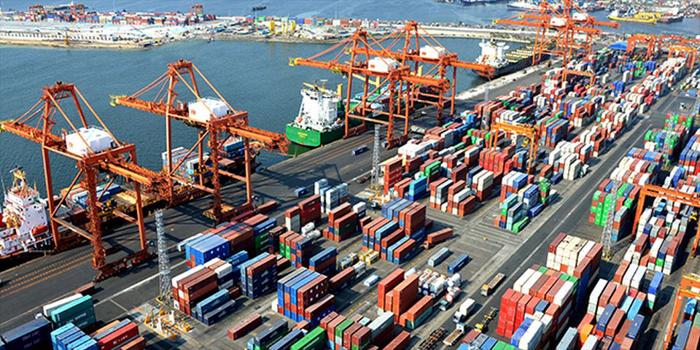
Container spot freight rates on the transpacific trade saw another week of double-digit gains, as carriers forced prices with the détente in the US-China trade war continuing.
Smaller increases were seen on Asia-Europe, but forwarders questioned whether these would stick as everyone continues to look for signs of the peak season starting.
With the judgment from the US Court of International Trade declaring that many of President Trump's so-called 'reciprocal' tariffs invalid coming too late in the week to have a meaningful impact on freight rate indices, the previously announced 90-day pause was most likely the chief reason for the rate strength this week.
However, the considerable uncertainty surrounding US trade policy undoubtedly affected pricing on the transpacific: Drewry's World Container Index's (WCI) Shanghai-Los Angeles leg gaining 17% week on week, to end at 3,788 per 40ft, while the Shanghai-New York route was up 14% week on week, at $5,172 per 40ft.
Additionally, the SCFl's Shanghai-US east coast base port was up 46% week on week, to $6,243 per 40ft, more than $1,000 above the WCl index on the route.
A jump in transpacific spot rates next week would make sense, given that carriers have general rate increases (GRIs) of $1,000 to $3,000 per 40ft due to be implemented on 1 June (Sunday).
Meanwhile, North European buyers of Asian spot freight cargo also encountered higher prices this week, the first rise since early April, after the WCI's Shanghai-Rotterdam leg recorded a 6% week-on-week rise to $2,159 per 40ft and a 3% gain on the Shanghai-Genoa route, to $2939 per 40ft..
And if today's SCFl is correct, they may face higher rates next week, with the Shanghai-North Europe base port leg up 20% week on week, to $3,174 per 40ft, and the Shanghai-Mediterranean base port up 31%, to $6,122per 40ft.
It may be that the SCFl numbers reflect the new FAK rates levels announced by carriers for 1 June, aiming for $3,100-$3,300 for North Europe shipments and $4,400-$5,000 to the Med.
However, forwarders on the trade expect the rally to be short-lived.
There's no significant increase in demand yet, and bookings from Asia to Europe are so far going through without issue.
However, another forwarder on the trade noted that "carriers are telling us the large BCOs are peaking volume right now, plus, with their blanked sailings, the vessels are full - so there is definitely an element of peak season at play".
Zim has announced a $1,400 per 40ft peak season surcharge (PSS) on Asia-Europe shipments from 6 June, with CMA CGM set to implement a $1,000 per 40ft Asia-Mediterranean PSS on 7 June.
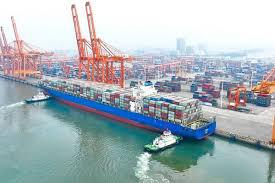

Any shipper waking up to discover that large swathes of President Trump's tariffs have been ruled illegal should not celebrate just yet.
The White House has submitted an appeal against the judgment by the Us Court of International Trade that ruled that the president had overreached his authority in imposing reciprocal and fentanyl tariffs by using the International Emergency Economic Powers Act (IEEPA).
The court gave the Trump administration 10 calendar days to issue "necessary administrative orders" to end the impacted tariffs - but the White House appeal requests seven days to "to allow time for the Federal Circuit to consider a motion to stay and request for administrative stay".
Responses to the White House's motion to suspend the order, pending appeal, are due by 18 June - a more than two-week wait.
While it is highly likely that the decision will end with the Supreme Court, the White House has other tools at its disposal to introduce tariffs.
Meanwhile those on autos, steel, and aluminium remain, as they were invoked under a different law.
The question that remains unanswered for shippers with freight en route to the US will be how the Customs and Border Protection agency (CBP) deals with imports when they arrive - in theory, US importers can ask for a refund on tariffs paid already, but whether that will be enforceable is again unknown.
Even if Mr Trump loses his appeal, under the Trade Act of 1974 the president is able to impose tariffs of 15% for up to 150 days on countries with which there is a big trade deficit.
In submitting an appeal and asking for a 'stay', or pause, on the judgment, the president's lawyers wrote: "In sharp contrast to the extraordinary harm to defendants, a stay will not substantially injure the plaintiffs. For any plaintiff who is an importer, even if a stay is entered and we do not prevail on appeal, plaintiffs will assuredly receive payment on their refund with interest.
"There is virtually no risk' to any importer that they would not be made whole' should they prevail on appeal. The most 'harm' that could incur would be a delay in collecting on deposits. This harm is, by definition, not irreparable. Plaintiffs will not lose their entitlement to refund, plus interest, if the judgment is stayed, and they are guaranteed payment by defendants should the court's decision be upheld. And defendants do not oppose the reliquidation of any entries of goods subject to lEEPA duties paid by plaintiffs that are ultimately found to be unlawful after appeal."
The judgment gave some colour as to the challenges faced by US importers due to the tariffs.
Twelve states, as well as five importers, led by wine importer VOS Selections, showed that the tariffs were "likely to cause an economic injury", as well as "difficulties with sourcing and pricing", and also that "the reduction in cash flow caused by increased tariffs also necessarily reduces the company's inventory and the level of business that VOS can conduct, leading to an overall reduction in purchase orders...".
VOS argued that the tariffs put "a large, immediate, strain on its cash flow", while fellow plaintiff Genova Pipe pointed to sourcing problems, claiming: "Tariffs will directly increase the cost of raw materials,
• manufacturing equipment, and resale goods imported from abroad by Genova Pipe".
MicroKits alleged that at the current rates, it "cannot order parts from China and will have to pause operations when it runs out of parts", and also that as a result it "will likely be unable to pay its employees, will lose money, and as a result may go out of business".
FishUSA noted that tariffs had "caused [it] to delay shipment of finished goods from China due to the unpredictability of the tariff rate that will be imposed when the product arrives, and [that] it has also paused production of some products", and that these conditions inhibited its business growth.
And Terry Cycling claimed it had "already paid $25,000 in unplanned tariffs this year for goods for which Terry was the importer of record", and there were "projects that the tariffs will cost the company approximately $250,000 by the end of 2025".
The court judged that the Trafficking Orders - ie, the fentanyl tariff - did not "deal with" its stated objectives. It added: "Rather, as the government acknowledges, the orders aim to create leverage to 'deal with' those objectives.
"A tax deals with a budget deficit by raising revenue. A dam deals with flooding by holding back a river. But there is no such association between the act of imposing a tariff and the unusual and extraordinary threat[s] that the Trafficking Orders purport to combat," ruled the court.
And the worldwide and retaliatory tariffs, meanwhile, "exceed any authority granted to the president".
• It summed up: "The court holds, for the foregoing reasons, that lEEPA does not authorise any of the worldwide, retaliatory, or trafficking tariff orders.
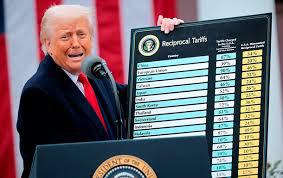


The first signs of guidance on how tariffs could play out over the next few months was issued this week by a leading expert on US trade policy.
At a webinar organised by the European Shippers’ Council (ESC), Eugene Laney, CEO of the American Association of Importers and Exporters (AAIE), said his organisation was beginning to get a sense of where US tariff levels will eventually settle.
With the 90-day pause of the US’s so-called reciprocal tariffs on its trade with the rest of world set to expire on 9 July, and the 90-day window of reduced tariffs between China and the US due to expire on 12 August, Mr Laney said: “We really believe the place that they’re going to settle on 9 July will be 50% for China and 10% for everyone else.
“But, of course, all of this can change, as we’ve seen over the last few weeks,” he added.
Describing the 145% tariff on Chinese imports as “basically an embargo”, Mr Laney explained some of the knock-on effects the tariff chaos had had on American importers, and why so many smaller firms immediately cancelled shipments.
“There’s a huge cost for US importers, as it relates to import bonds – every time the tariffs go up here in the US, you need an import bond to facilitate that customs transaction at the border,” he said.
US Customs and Border Protection (CBP) agency requires a bond, which will cover all duties on any import valued at more than $2,500, and can either be bought on a single-entry basis, or annually, covering multiple imports.
“If you’re bringing in $3m of imports and then the tariffs go up 145%, you then have to increase your import bonds, and you have to carry that bond for up to a year,” said Mr Laney.
“We’re seeing a lot of companies having to put down higher collateral to get these import bonds, and we’re also seeing a lot of small- and medium-sized businesses unable to meet collateral needs to get a bond, so they’re being forced to walk away from some imports.” he said.
He warned that this would likely lead to some shortages of products – particularly low-value items – across the US in the coming months, as the tariff shock worked through the supply chain and importers focused on higher-value goods, with which they were more confident of being able to pass on the tariff cost increases.
“If they bring goods in, they’re focusing more on the premium imports. In other words, imports where they can pass on the tariffs into the price; versus the low-cost consumer goods, which you’re seeing being removed from a lot of the imports because you’re not going to be able to recoup your costs.
“We undoubtedly think you’re going to see some summer and autumn shortages of goods. I know the news is predicting that’s not going to happen, but the reality is that it will, because you’re just not seeing the type of velocity of goods coming into the US. What you’re seeing is everyone trying to stockpile, to try to make it through the best way they can through autumn and summer,” he said, and added that efforts to try and get exporters to US to absorb some of the higher costs had largely failed.
“They’re having a hard time applying pressure on suppliers, mainly because we’re seeing a lot of suppliers fearing national retaliation. A lot of Chinese suppliers have the Chinese government telling them they cannot absorb those tariff costs.
“We’re seeing that in other countries – most foreign suppliers are not absorbing the cost. They’re asking US importers to take on that cost. There’s not a true share burden around the tariffs,” he said.


Container spot freight rates on the transpacific continued to trend upwards this week, albeit at a far gentler pace than last week’s GRI-induced double-digit growth, as carriers rushed to return capacity in anticipation of at least a short-term demand bounce.
There are only rough estimates as to how much ready-to-load cargo has built up in China, waiting to ship to the US, since President Trump’s so-called reciprocal tariff announcement.
Sea Intelligence consulting suggested a broad range, of 180,000-540,00 teu, this week; and this was given some credence by Jim Boone, chief commercial officer at US intermodal provider CSX, who told a Wolfe Research event this week according to DeskOne: “We expect a lot of volume coming into the ports here as we move into July and into the third quarter with the 90-day relief on the tariffs from China.
“And we’ve heard from a number of customers, there’s 700,000 to 800,000 loaded containers ready to go,” he added.
Carriers have reacted incredibly quickly: consultant Linerlytica yesterday reported that “all of the Far East-US west coast transpacific services that were withdrawn in April and May will be fully re-instated following the rebound in cargo demand” with the China-US détente.
And today, Drewry warned that “carriers are reinstating suspended services and upsizing vessels to meet booming demand, yet near-term capacity remains tight due to redeployments and congestion, especially at Chinese ports”.
The effect on spot rates this week was muted however, with WCI’s Shanghai-Los Angeles leg showing a 2% week-on-week gain, to $3,197 per 40ft, while the Shanghai-New York spot rate rose 4%, to $4,257 per 40ft, and the Shanghai Containerised Freight Index (SCFI) saw week-on-week rises of 5% on both routes, to reach $3,275 and $4,284 per 40ft, respectively.
The acid test for the trade, and the prognosis for the remainder of the tariff time-out period to 9 July, are likely to be the stickiness of two general rate increases (GRIs), of $1,000-$3,000 per 40ft, slated for 1 and 15 June.
It is also unclear whether 90 days of reduced tariffs will be enough to boost demand. A Freightos survey of more than 100 US small-to-medium importers found there was still considerable concern over remaining tariffs, and which would likely be exacerbated by sharp freight rate rises.
“The 90-day tariff implementation delay hasn’t done much to ease importer concerns,” Freightos said. “Smaller importers remain deeply anxious, and are shifting behaviour – including changing shipment timing or even contending winding down their businesses – and are starting to adapt for the long term.
“While some are assessing domestic manufacturing, very few actually have. Meanwhile, delays in shipments as a result of tariffs led to significant gaps that importers are struggling to fill,” it added.
Meanwhile, spot rates on the Asia-Europe trade continued to flatline – the WCI’s Shanghai-Rotterdam leg was unchanged, at $2,030 per 40ft, while the Shanghai-Genoa leg was up 4% week on week, to $2,841 per 40ft.
With a series of rising carrier FAK spot rates due on 1 June, which would mean a 50% hike of current prices, forwarders and shippers will begin to see how demand is shaping for the peak season: whether capacity continues to outmatch demand; and the effect of the growing port congestion in Europe.
Outside the two largest east-west trades, evidence emerged this week that spot rates on some secondary trades were being hit by the capacity reshuffling on the transpacific.
The Ningbo Containerised Freight Index noted that spot rates on the Asia-South America west coast had surged over the past week.
“Affected by increased demand in North America, some box liners have significantly redeployed capacity from these routes, resulting in space shortages and substantial freight rate increases,” reported an NCFI commentary; its Ningbo-west South America rate up 71.7% against last week.
Similarly, the SCFI’s Shanghai-Manzanillo route showed a 50% week-on-week gain, to end at $2,387 per 40ft.

In the early days of the Houthis’ Red Sea denial, the rebel militia, known to be working with Iran, professed to be attacking ships with connections to Israel. It was soon discovered, however, that trying to figure out which ships were linked to which countries was harder than sighting them up for missile strikes.
Before even the tangled business of ownership comes into play, a ship might be built in China, managed in Singapore, on charter to a German liner, with a crew of Filipinos. In this context, some tenuous business link to Israel was inevitable for almost any ship.
This prompted remarks from a frustrated Lars Jensen, Vespucci Maritime CEO, that as well as the UK, the targeted bulk carrier Rubymar had links with Belize, whose flag it flew, the Marshall Islands, Lebanon, Honduras, UAE, Bulgaria, and Saudi Arabia.
“It serves as a good illustration as to the futility of trying to assign a single ‘nationality’ to a vessel,” Mr Jensen said. “Shipping is simply too global and complex for that approach to have much meaning.”
Moving freely about in the world and, irrespective of location, having the power to decide which country’s laws to follow, and whose police would come after you if you broke them; for now, even the loftiest billionaires could but dream of such free rein for themselves. But for a ship, it is another matter. Vessels can fly the flag of a country that no-one involved in its ordering, construction, or operation need ever have visited.
The practice of flagging your ship in a country with business-friendly provisions has been given the moniker ‘flag of convenience’, or FOC. But while flagging a vessel in a country that does not intend to impose taxes on it is even easier than opening a Bermuda bank account, there is a lot more than money at stake in case of a ship registry.
A flag provides a regulatory framework to be applied to the ship, in matters of labour and crewing, technical specification, safety, and pollution. It also pledges a degree of protection, both legal and, in some cases, military.
By contrast, the US flag is a special case. A protectionist local content law, the Jones Act, strives to keep US ships owned, built, and crewed by Americans. A high cost of entry for the US market does not sit well with globalised maritime players, and the US-flagged fleet has been contracting for decades, dwindling to fewer than 200 ships.
For the Trump administration, this is a matter of some embarrassment, and something must be done.
Tariffs and US Trade Representative (USTR) port call levies on foreign ships would, it hoped, give the US the means to reinvigorate US shipyards and build a new US fleet sufficiently big and beautiful for the modern age.
But a separate plot is under way. One group is hoping to persuade the administration to open a new US flag of convenience, the proposed US Virgin Islands (USVI) registry. Vessels would call freely at US ports, while decisively undercutting the US flag.
It is the second attempt to get this flag started, following an attempt in 2022 which seemed to be shunned by the pro-union Biden Administration.
“The initiative makes sense and is in alignment with the Trump administration’s initiative to strengthen American shipping,” Virgin Islands Governor Albert Bryan told Reuters. “We are very excited and look forward to being able to support this initiative to its fruition.”
The scheme’s advocates will not be reassured by a new Federal Maritime Commission (FMC) investigation into FOCs announced this week. Opening a 90-day public comment period, FMC is looking for “unfavourable flagging laws, regulations, and practices” that, from a US point of view, “endanger the efficiency and reliability of the ocean shipping supply chain”.
Not unexpectedly, following the tantrum at MEPC 83, this has involved lashing out at the International Maritime Organization (IMO), which is supposed to agree on a law of the sea (UNCLOS) to provide a minimum code of ethics for even the most feckless flags to follow. IMO “has not brought about meaningful change nor deterrence to what is clearly a growing problem” argues the FMC. Instead, global flag administrations have been encouraged to participate in a “race to the bottom”.
The commission added: “By offering to register and flag vessels with little or no oversight or regulation, countries may compete against one another to gain revenue from the associated fees, and to minimise the expenses associated with inspecting vessels, and ensuring compliance with appropriate maintenance and safety requirements.”
The US has determined that it must have its own shipping fleet, but faced with two opposed strategies for achieving this, the Trump administration must now choose between doing it the hard way, or the way of convenience.


Supply chain leaders have given a mixed response to France and Germany’s calls to abolish the EU Corporate and Sustainability Due Diligence directive (CSDD).
Coming hot on the heels of newly elected German chancellor Friedrich Merz’s demand for the CSDD’s “complete repeal” this month, French president Emmanuel Macron echoed that sentiment on Monday in a speech at Versailles.
Eliciting cheers from an audience of business executives, Mr Macron said: “CSDD and other regulations have to not just be postponed, but need to be taken off the table completely.”
Supply chain executives in Berlin and Paris have varyingly described the CSDD – it requires companies to monitor global supply chains for human rights abuses and sustainability violations – as “onerous” and “essential”.
One forwarder told that the call was a “smart one”, believing the directive meant Europe was “shooting itself in the foot” and putting businesses on the continent at a “major disadvantage” to global competitors.
They added: “I want to stress that my objection to the directive is nothing to do with the issue of environmental and human rights abuses – all companies are addressing this themselves. What I object to are these onerous norms that penalise EU companies for what happens on the other side of the planet.
“We are in a global economy – why is it that European firms are taking the hit for exploitative practices that everyone else is capitalising on?”
Since 2010, demand for cobalt has more than trebled as a consequence of surging demand for electronics, including smart phones, laptops, and electric vehicles. Leading the supply is the Democratic Republic of Congo – which has the world’s largest cobalt reserves – and in that period, Amnesty International claims, the DRC has witnessed an escalation in human rights abuses, including forced evictions to access mines.
Secretary general of the European Shippers Council Godfried Smit told that while the CSDD’s objective is important, the way it was addressing these challenges “was causing a high level of administrative burden,” noting that smaller businesses are particularly exposed to negative impacts.
Mr Smit added: “Starting with leading companies might be a good choice. We hear from these companies that they are well prepared. Abolishing the objective would lead to disinvestment by these companies. If serious cases of bad practice are reported, there remains an obligation to investigate. If the Commission does not proceed, there is a risk of a patchwork of national legislations.”
However, another European forwarder warned that “scrapping or weakening these frameworks may offer short-term relief to some but also risks sending the wrong signal when unified and credible standards are more necessary than ever”.
There are suggestions that the call from France and Germany is a response to the current belief in Washington that business is now being prioritised above all else, as the bloc looks to secure trade deals with the Trump administration.
They told: “Fragmentation across member states could lead to even greater uncertainty in the long run. The directive gave structure and visibility to that work.
“We experienced genuine appreciation from clients, partners, and stakeholders for taking these responsibilities seriously. The goal should a balanced, practical implementation – one safeguarding competitiveness without compromising collective sustainability commitments.”
Noting similar pushback on the Corporate Sustainability Reporting Directive (CSRD), they said that the framework had provided “a strategic advantage – it helps build trust with partners, ensures future readiness, and strengthens positioning in sustainability-driven markets”.
Both forwarders noted that the societal push seemed firmly rooted in adopting humane, sustainable practices and that while short-term limitations may keep the market open for abuses, businesses needed to be looking to the long-term, with those failing to heed the ground shift setting themselves up for failure.
One forwarder said: “CSRD can, and should, be seen as an opportunity to establish transparency, credibility, and long-term resilience in our business practices”.


Welcome a new company on MaxModal. You can see Blue Ocean Freight System Ltd services on their business profile, drop them a message, add them to your contacts or submit a special request to them
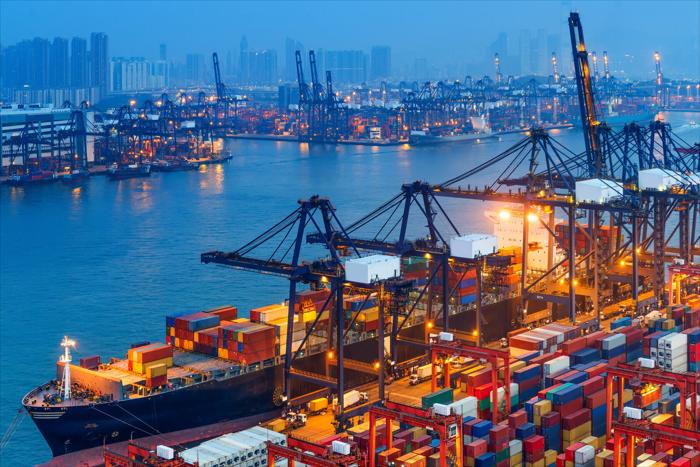
Transpacific shippers keen to take advantage of the 90-day tariff time-out are likely to be faced with tight capacity and soaring freight rates as new volumes collide with delayed cargo.
According to new analysis from Sea-Intelligence Consulting, there is 180,000-540,000 teu of cargo in China that formed a ‘cargo pool’ in the immediate aftermath of President Trump’s “Liberation Day” tariff announcement on 2 April.
The estimate is based on widespread reports of a 30-40% decline in bookings post tariffs, and an assumption that between 25% and 55% of the cancelled bookings was for cargo already produced and subsequently stored in bonded warehouses and container freight stations in China.
Sea-Intelligence analysts further calculate that if this pool were added to the normal transpacific cargo flows over the remainder of this month, it would lead to a demand surge of 16%-48%; while if shipped during May and June, demand would grow by a far more manageable 5%-16%.
But they added: “It does not take into account that we might expect a clear and rapid surge in peak season cargo, as US importers will attempt to move as much product as possible before 14 August.”
Indeed, OceanX founder Ruben Huber noted: “The reprieve from the US-China agreement for the next 90 days seems to have a triggered an early peak season, with bookings back up and importers embracing the window of certainty, even though at a still high tariff and likely higher ocean rates too.”
Despite the demand swing, carriers have yet to return capacity to the trade en masse, said Sea-Intelligence, noting that capacity on Asia-US west coast services is down 5% this week and down 3% next week, year on year.
And, while the week beginning 2 June could see capacity 5% up year on year, according to current service announcements from carriers, it is expected to decline again and, by the end of the month, is expected to be almost 10% down year on year.
The Asia-US east coast trade currently appears to be better equipped to handle an early peak season – this week’s capacity is at the same level as last year and is expected to rise throughout June to hit a 30% year-on-year increase at the end of the month.
Sea-Intelligence explained that it expected to see fresh capacity injections announced in the coming days, but questioned whether it would be enough to mitigate sharp freight rate increases.
“It is very likely that we will see a substantial increase of cargo in the coming weeks. This can better be managed if the [waiting] pool is distributed over the next six weeks – or longer.
“However, it is very likely that shippers will be anxious to move their cargo as fast as possible, before they are blindsided by new tariff changes.
“Consequently, we expect to see a sharp rise in spot rates in the coming weeks, as well as much more capacity insertion into the transpacific – at the expense of blanked sailings in other Asian export trades,” it said.
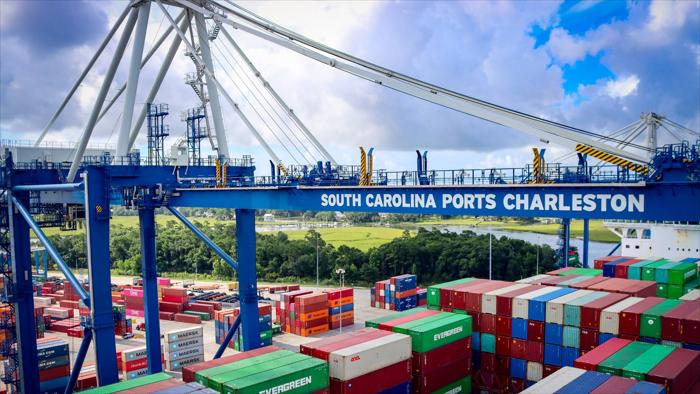
In April, the Port of Charleston handled 215,804 TEUs and 118,215 pier containers, which is flat compared to the year prior.
Container volumes remained relatively consistent in April, following two months of container growth, according to SC Ports.
Vehicle imports and exports at the Port of Charleston totaled 12,339 in April, representing a 32% decrease from last year, while railed cargo continues to be a bright spot, with both Inland Ports Greer and Dillon handling strong volumes in recent months.
Inland Port Greer achieved a record April with 18,394 rail moves, representing 14% growth from last April. Greer's recent expansion increases cargo capacity by 50%, enabling the rail-served inland port to handle 300,000 rail lifts to support growing customer demand in the region.
Inland Port Dillon handled 4,213 rail moves in April. This is down 11% year-over-year, but breaks 4,000 rail moves for the first time this fiscal year.
"We are proactively investing in our port terminals and rail infrastructure to support the growth occurring in the Southeast for the long-term," said SC Ports President and CEO
Barbara Melvin. "As volumes fluctuate in the short term, we are committed to providing fluidity for companies' supply chains."
Maersk has joined its peers in implementing ’emergency operational surcharges’ on cargo in and out of Pakistan that has been disrupted due to the recent trade cut-off with India.
The Danish carrier will begin charging $500 per container for Pakistan exports to major western markets and $300 per box on the inbound leg, starting on 21 May for non-regulated countries, and 13 June for regulated trades – with the exception of Vietnam where it starts on 29 May.
But Pakistan exports within the region, mainly the Persian Gulf and subcontinent, will attract $300 per container.
“In light of the recent developments that are impacting the movement of cargo between India and Pakistan, there have been restrictions on trade and marine traffic between the two countries,” Maersk said.
“To ensure we continue providing a high level of service we have made changes to our network and operations and these have necessitated implementing an emergency operational cost recovery surcharge.”
Additionally, the carrier explained, the restrictions at both ends were constantly evolving, Pakistan now allowing Indian exports/imports remaining on board to transit its ports, and India updating its protocols to permit Pakistan ‘imports only’ to pass through its ports.
The surcharge scale compares with the $800 per container levy announced by CMA CGM and MSC for shipments out of Pakistan.
Maersk, in a separate trade advisory, noted that port activity in the region, which had seen some disruption due to the military face-off, were now back to near normal operation. That concern in large part surrounded repeated operational suspensions at Mundra port in India, because of the then high security threat.
The carrier had already cut back on its direct coverage of Pakistan trade by removing a call at Karachi on its MECL service connecting to North America, and replacing it with Mundra as part of global network adjustments in tandem with the Gemini Cooperation launch in February.
Maersk, through Gemini and independently, is increasingly concentrating West Asia operations at Salalah port in Oman.
With the India-Pakistan trade disruption, Maersk’s Gemini, partner Hapag-Lloyd, has also begun using Salalah for Pakistan transhipment.
More carriers have reorganised their Indian subcontinent operations in anticipation of “prolonged supply chain pressures”, as both governments are unlikely to budge on their trade embargoes and other diplomatic positions, despite talks taking place at military level, sources believe.
ONE has now halted direct Karachi calls on its standalone WIN service between India and North America, but it will instead use Sri Lanka’s Colombo port for connecting Pakistan exports, and Singapore port for transhipment of Pakistan imports. Its reworked TIG and TIP services, covering Asian trades, will essentially handle Pakistan cargo relays.